

BLOG
No NHL Without Multisport
Based on the Dutch Athletic Skills Model (ASM), we show why soccer, basketball, or judo can give hockey players real superpowers: quick feet, lightning-fast decisions, and fewer injuries.
In today’s lightning-fast, creative, and physically demanding world of ice hockey, success depends not only on hours spent on the ice but on the comprehensive movement culture that multisport provides. Based on the Dutch Athletic Skills Model (ASM), we walk through the theoretical and practical elements of youth movement development to show why soccer, basketball, or judo can give hockey players real superpowers: quick feet, lightning-fast decisions, and fewer injuries.
-This article was compiled by the Icehockeypro57 team under the leadership of Attila Orbán, where all professional resources for individual player and goalie development are available-
The creation of the ASM began in 1995 in the Netherlands, when Rene Wormhoudt started revamping movement training at AFC Ajax; today it has more than 5,000 certified coaches and is one of the defining frameworks of Dutch youth sport, applied at Ajax and the Dutch national team for talent development. Since its beginnings, stars such as Frenkie de Jong (Barcelona), Matthijs de Ligt (Bayern Munich), Donny van de Beek (Manchester United), and Justin Kluivert (RB Leipzig) have grown up at Ajax.
“Athlete first, specialist second.” - This is the ASM’s motto, meaning that athletes must first be developed into well-rounded individuals with athletic foundations before specializing in a given sport. The model is built on the following principles:
-
Physical intelligence development: Developing agility, flexibility, stability, and coordination through varied movement programs.
-
Versatile movement training: Developing basic movement skills (BMS), coordinative abilities (CA), and conditions of movement (COM) before sport-specific skills.
-
Long-term development: Prioritizing diverse movement experiences over early specialization reduces the risk of burnout, injuries, and dropout.
-
Adaptability: Developing the ability to adapt to changing environmental conditions, such as different surfaces or weather conditions.
-
Joy and motivation: Maintaining the joy of movement and playfulness so that athletes remain motivated in the long term.
Multisport means that young athletes practice several sports simultaneously or seasonally, providing diverse movement experiences. This approach promotes the development of versatile motor skills, coordinative abilities, and movement conditions, reducing the risk of injuries and increasing creativity.
Multisport ice hockey players develop faster in hockey because diverse movement experiences enrich motor skills and improve adaptability. The comprehensive movement culture - which, according to the ASM, means versatile movement development - accelerates the learning of hockey skills by promoting skill transfer, increasing neurological plasticity, and making players more motivated. This is especially relevant for young hockey players, where the ages of 6-12 are the “golden period” for motor development.
How Does Multisport Help? - The Transfer of Motor Skills
Motor skill transfer can occur in two main forms: specific and general transfer. Specific transfer is particularly important because it allows players to develop directly applicable skills. Research shows that cross-sport transfer is more specific when the action opportunities are similar. For example, roller hockey (inline) can help develop skating techniques, puck handling, and shooting - and it is no coincidence that the Michigan move is often called a lacrosse goal, since it came into hockey from lacrosse. This direct transfer can make the acquisition of hockey skills more efficient, especially during the summer season when there are fewer opportunities for on-ice training.
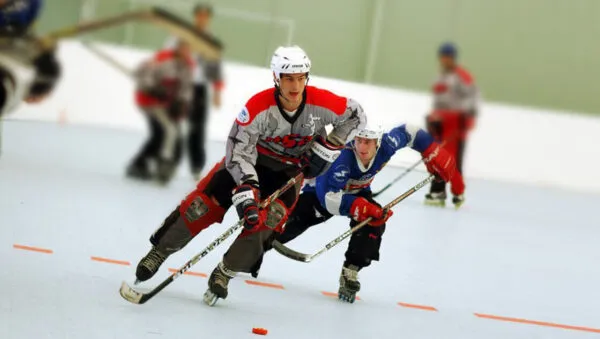 Roller hockey movement is 85-90% identical to ice hockey - a perfect donor sport / icecourt.com
General transfer strengthens the physical foundations that are useful in every aspect of hockey. Although on-ice agility training is more effective, off-ice agility training is also transferable to on-ice performance. General physical abilities such as agility and stability can support sport-specific skills. Other sports, such as judo or soccer, can develop general skills such as balance and endurance, sometimes even better than ice hockey.
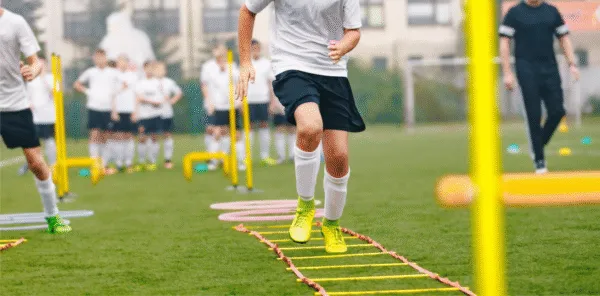 Training for quicker feet / cupello.com
Judo, as a martial art, excellently transfers basic movement skills, reinforcing body-to-body combat and safe falls in ice hockey collisions.
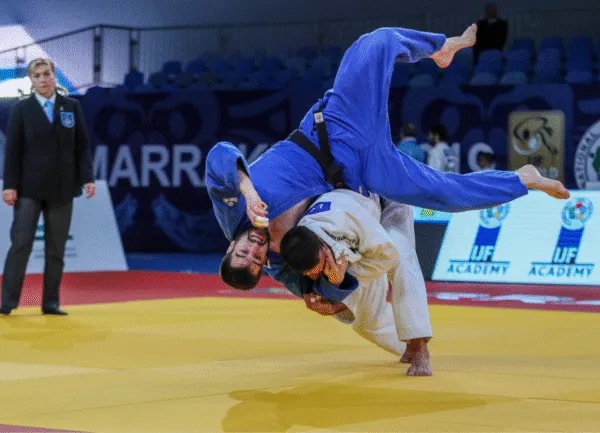 Compared to judo, a battle along the boards is a walk in the park / ijf.org / GUILHEIRO (white judogi) throws URQUIZA SOLANA (ESP)
Why Do Multisport Hockey Players Develop Faster?
Versatile movement development significantly accelerates the learning of hockey skills: transferable skills from various sports provide 15-20% faster motor learning, stimulate neurological plasticity, reduce monotony, increase flow experiences and motivation, and by avoiding burnout and injuries allow for continuous development:
-
Developing varied motor skills: Playing multiple sports builds a wider movement repertoire that transfers to hockey. Multisport hockey players show better balance, speed, and coordination, resulting in 15-20% faster development in hockey-specific skills (e.g., puck handling, shooting).
-
Injury prevention and sustainable development: Multisport reduces overuse injuries that can slow development later. The varied load balances the repetitive movements of hockey, enabling continuous training. This results in faster development because players spend less time injured.
-
Cognitive and psychological benefits: Multisport increases game intelligence and decision-making, as different sports require different problem-solving. It also reduces burnout and maintains motivation, enabling faster learning in the long run.
-
Improved physical fitness: Multisport develops aerobic capacity, strength, and agility (e.g., improved VO2max), which are crucial for hockey’s intense, intermittent demands. Multisport hockey players are faster and more agile on the ice.
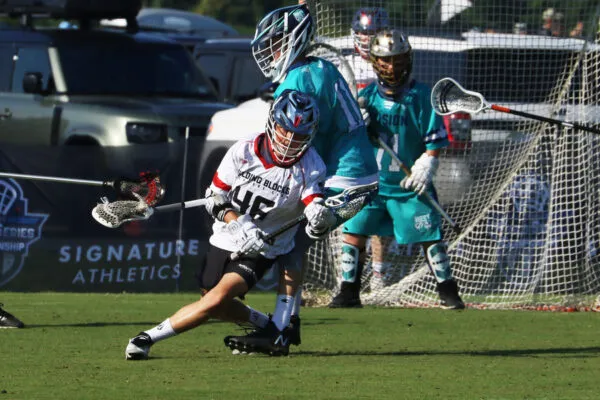 Lacrosse is the most popular childhood sport among NHL players / Photo: Matt Kinnear, insidelacrosse.com
At What Age Do NHL Players Specialize?
NHL players specialize on average at 14-16 years of age (meaning they focus exclusively on a single sport, ice hockey), which is later than in many other sports. According to a 2018 NHL/NHLPA survey:
-
The average NHL player began skating and playing hockey after the age of 4.
-
The most common age of specialization (mode) is 16.
-
Only 12% specialized before the age of 12 (among NCAA and NHL players).
-
Among elite hockey players, there is no significant difference in the age of specialization between Division 1, Division 3, and NHL players, but the majority focused exclusively on hockey after age 14.
Most common secondary sports and their percentages (among NHL players, based on various studies):
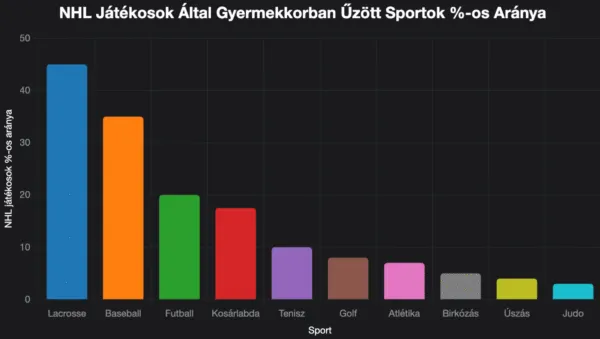
Life Without Multisport - The Effects of Early Specialization
When a child focuses exclusively on ice hockey from a very young age, not all motor skills develop adequately. Ice hockey - not surprisingly - takes place on ice, on skates, which limits the practice of certain fundamental movements. Among basic motor skills, ice hockey includes striking (puck handling, shooting), balancing (dynamic and gliding balance), catching (receiving the puck), to a lesser extent fighting and wrestling (body-to-body combat, collisions), and running (movement built on the pattern of skating). These skills develop strongly due to the nature of the sport, but the other BMS are left behind, which is disadvantageous in the long term.
-
Jumping: Jumping is minimal in hockey, yet it is key for developing explosiveness and landing mechanics. In other sports (e.g., basketball, athletics), it develops naturally. Its absence can limit a hockey player’s agility and injury prevention ability, as jumping strengthens muscles and joints.
-
Throwing: Striking the puck is not the same as the classic throw (e.g., throwing a ball or medicine ball), so the full development of upper-body strength and precision is missing. This skill is important for strengthening shoulder and arm muscles, which would also be useful in hockey for shooting, but does not receive enough emphasis in the case of specialization.
-
Kicking: Kicking develops leg coordination and lower body strength, which transfers to skating (e.g., direction changes). Its absence can weaken a hockey player’s endurance and balance, increasing the risk of injury (e.g., knee or ankle problems).
-
Climbing: Without climbing (e.g., rope or wall), upper body strength and coordination do not develop fully. This skill strengthens the shoulders, back muscles, and grip, which would be useful in hockey for puck protection or collisions. In the case of specialization, its absence can limit physical robustness.
-
Rolling: Rolling (e.g., somersaults, tumbles) is also not part of the hockey repertoire, so falling technique and body control are lacking. Rolling improves body awareness, which is crucial in hockey for collisions, and its absence can increase injuries, especially among younger age groups (Lundgren et al., 2016, Journal of Clinical Sport Psychology).
Ice hockey, especially in the case of early specialization, does not fully develop among coordinative abilities rhythmic ability and static balance, since the sport takes place in a dynamic, chaotic environment that primarily strengthens spatial orientation, reaction ability, and dynamic balance. The lack of rhythmic ability hinders the fluency of movements and creative decision-making, such as precise timing of passes, while the lack of static balance increases the risk of injuries during collisions and falls. The multisport approach is ideal to compensate for these: dance or jump rope develops rhythmic ability, promoting harmony in skating and passing, while yoga or slacklining strengthens static balance, improving body control and reducing the risk of injuries.
In ice hockey, early specialization supporters highlight short-term benefits, such as faster acquisition of technical skills (e.g., skating, shooting) through intensive practice, which initially increases performance. However, the majority of research emphasizes long-term disadvantages: increased risk of injury and burnout, limited creativity and movement variability which hinders game intelligence, and performance decline in adulthood, since multisport athletes are more successful, have longer careers with fewer injuries.
Players who grow up with early specialization may have better technical foundations in certain areas, but are more mechanical and less creative in the modern, fast-paced NHL. This rather hinders the development of the sport, narrowing the talent base (higher dropout rate), reducing creativity, and increasing the risk and cost of injuries.
Classifying Movements
Before we move on to the recommended multisports, let’s look at what movements need to be learned in the first place. The Athletic Skills Model (ASM) uses a concentric approach where basic movement skills (BMS), coordinative abilities (CA), and conditions of movement (COM) develop in layers as the athlete progresses. BMS serves as the foundation, developed in a playful manner at an early age so that children acquire a wide movement repertoire. CA builds on this, refining the precision and adaptability of movements. COM provides physical support for BMS and CA, enabling movements to be performed with high speed, strength, and endurance. During integration, these skills merge with sport-specific techniques, so specialization only begins after a solid foundation is in place, avoiding the risk of early injuries and burnout. The ASM structure:
- Basic Movement Skills (BMS): These are the fundamental forms of movement that form the basis of every sport:
Running
-
Jumping
-
Throwing
-
Striking
-
Kicking
-
Climbing
-
Rolling
-
Balancing
-
(Playful) fighting and wrestling
-
Catching
-
Coordinative Abilities (CA): These abilities serve to fine-tune movements and develop adaptability:
Adaptation: Adapting to different conditions (e.g., playing on hard or slushy ice).
-
Balance: Maintaining static, dynamic, rotational, aerial, and gliding balance.
-
Kinetic differentiation: Precise regulation of the strength and direction of movements (e.g., shooting with pucks of different weights).
-
Reaction: Quick response to external stimuli (e.g., goalie reflexes).
-
Rhythmic ability: The timing and rhythm of movements.
-
Spatial orientation: Navigating in space (e.g., sensing the player’s position on the rink).
-
Synchronization: Linking multiple movements (e.g., combining a jump and a throw).
-
Conditions of Movement (COM): These are the physical conditions necessary for executing movements:
Agility: Quick direction changes and mobility.
-
Mobility: Increasing the range of motion of joints.
-
Stability: Controlling the body during movement (e.g., core stability).
-
Strength: Developing musculature, especially explosive and maximal strength.
-
Endurance: Developing aerobic and anaerobic capacity.
-
Speed: Executing fast movements.
According to the ASM, the sensitive period for basic movement skills is ages 6-12 (peak: 6-10), for coordinative abilities ages 8-14 (peak: 10-14), and for conditions of movement ages 12-16, tied to PHV during puberty. For biological reasons (neurological plasticity, myelination, hormonal changes), BMS learning is 15-20% faster, CA 15-25% faster in a multisport environment, while COM is 10-15% more efficient during puberty.
How Do the Most Popular Hungarian Sports Help Ice Hockey?
The table below summarizes how sports popular in Hungary support the development of hockey players from a multisport or donor sport perspective. The table takes into account both specific transfer (skills directly related to ice hockey) and general transfer (general physical and coordinative skills).
Sport Multisport/Donor Sport Role Specific Transfer (BMS, CA) General Transfer (BMS, CA, COM) Most Useful Properties
Soccer Multisport and donor sport BMS: Kicking, leg coordination, transferable to the footwork of skating. CA: Spatial orientation for positioning on the rink. BMS: Running. CA: Reaction. COM: Endurance, agility. Leg coordination and spatial orientation to improve skating and positioning; endurance for intense play.
Swimming Multisport BMS: No direct transfer. CA: Rhythmic ability, timing of swimming cycles. BMS: Balancing in water. CA: Coordination. COM: Endurance, flexibility. Endurance and rhythmic ability for hockey’s long, intermittent demands; coordination for body control.
Handball Donor sport BMS: Throwing transferable to the power of shots. CA: Hand-eye coordination, passing, catching. BMS: Jumping. CA: Spatial orientation, Reaction. COM: Agility, strength. Throwing and hand-eye coordination to improve puck handling and shooting; agility for direction changes.
Basketball Donor sport BMS: Catching. CA: Hand-eye coordination, spatial orientation. BMS: Jumping. CA: Reaction. COM: Agility, jumping ability. Hand-eye coordination and passing skills for puck handling; jumping ability and agility for direction changes.
Water polo Multisport BMS: Throwing. CA: Spatial orientation. BMS: Balancing in water. CA: Rhythmic ability. COM: Endurance, strength. Endurance and strength for intense play; spatial orientation for positioning.
Fencing Donor sport BMS: Striking, precise movements transferable to shooting. CA: Reaction, kinematic differentiation. BMS: Balancing. CA: Spatial orientation. COM: Agility, speed. Reaction and precise movements for quick decision-making and puck handling.
Tennis Donor sport BMS: Striking. CA: Hand-eye coordination, reaction. BMS: Balancing. CA: Spatial orientation. COM: Reaction, agility. Hand-eye coordination and striking movements for puck handling; reaction for dynamic situations.
Athletics Multisport BMS: Running, jumping. CA: Rhythmic ability. BMS: Throwing. CA: Coordination. COM: Strength, speed, endurance. Strength and speed for shooting and skating; rhythmic ability for timing of movements.
Wrestling Donor sport BMS: Fighting and wrestling (body-to-body combat). CA: Adaptability, balance. BMS: Balancing. CA: Coordination. COM: Stability, strength. Fighting and wrestling for collisions; stability for body control.
Judo Donor sport BMS: Fighting and wrestling (body-to-body combat, falling technique). CA: Adaptation to changing situations. BMS: Rolling (control of falls). CA: Reaction, balance ability, synchronization. COM: Stability, strength, agility. Body-to-body techniques for collisions; falling technique and stability for injury prevention.
Overall, these sports not only complement the gaps in ice hockey but, through their versatility, promote the athletes’ long-term, injury-free development.
However, for complete movement development in ice hockey, soccer, basketball, and judo are the most recommended sports, as they complement the missing movement elements of hockey, support creativity, and are easily accessible in Hungary:
Soccer Basketball Judo
Why does it fit ice hockey? Outstanding as multisport: leg coordination, spatial orientation, and endurance transferable to skating. Popular, easily accessible, low cost. Donor sport: hand-eye coordination, passing, and jumping transferable to puck handling. Popular in Hungary, accessible at community level. Donor sport: body-to-body techniques and falling techniques support contacts and injury prevention. Increasingly popular for developing motor skills.
Specific Transfer Kicking (leg coordination, for direction changes).
Spatial orientation (positioning, tactical play). Catching/receiving (puck reception/pass).
Hand-eye coordination (precise pass/shot), spatial orientation (positioning). Fighting/wrestling (handling collisions), rolling (falling technique against injuries).
Adaptability (quick adaptation).
General Transfer Running.
Reaction (quick decisions).
Endurance (stamina), agility (direction changes). Jumping (explosiveness, injury prevention).
Reaction (quick decisions).
Agility (direction changes), jumping ability (body control). Balancing (body control).
Balance, coupling ability (linking movements).
Stability (core strength), strength, agility.
Most Useful Properties Improves skating, hockey IQ, and handling intense demands. Spatial orientation valuable for dynamic positioning. Improves puck handling, direction changes, and dynamic movements. Jumping ability useful for body control. Crucial for handling collisions and preventing injuries. Stability/strength increases body control. Stability and adaptability relevant for physical challenges.
Hungarian Context Widely accessible, low cost, ideal alongside limited ice rinks in rural areas. Popular at school/community level, easily integrated alongside limited ice time. Accessibility is growing, low cost, ideal for developing physical contacts.
Soccer, basketball, and judo complement ice hockey perfectly because they teach a wide variety of movements - such as jumping, kicking, and rolling - that are missing from hockey. Soccer develops spatial orientation and rhythmic ability on the pitch, while judo develops adaptability and balance, which is especially useful in battles along the boards, where quick reactions and a stable posture help maintain puck possession. Additionally, soccer strengthens endurance, basketball strengthens quick direction changes, and judo strengthens stability, allowing players to perform consistently well in hockey. These sports also increase creativity and game intelligence through their tactics, and they are easily accessible in Hungary and significantly cheaper than ice hockey.
Soccer and basketball as multisports develop game sense more effectively and faster than ice hockey alone, because the varied movement patterns and tactical situations stimulate spatial orientation, reaction ability, and creativity. This arose because the skill threshold for passing in soccer and basketball is much lower (running doesn’t need to be learned), while in ice hockey the level of skating technique and puck handling significantly limits the possibilities of play. Exactly fitting here is Zsolt Szoboszlai’s 2023 statement:
“I received a lot of criticism for it, but at our Főnix club we focus almost exclusively on technique from age 5 to 14. I am convinced that is the most important thing. If a child is technically perfectly prepared, they can choose the best option from the opportunities that arise in matches and execute it. But someone who is not properly trained technically will not be able to do this. We believe in this, and perhaps we are not doing poorly - we have given several top-flight and national team players to Hungarian football.”*
In which sport can triangulation be learned fastest?
Triangulation is key in all three sports for passing lanes and positioning, but it can be learned fastest in basketball due to the smaller playing area and fast decision-making situations:
-
Basketball: Learned fastest, since the smaller playing area and faster pace create simpler tactical situations, and hand-eye coordination supports quick decision-making. The learning speed is noticeably faster than in soccer or ice hockey, especially at ages 10-12.
-
Soccer: Learning speed is slower due to the large playing area and complex tactical situations.
-
Ice hockey: Medium speed, as the chaotic environment and skating make triangulation harder to learn.
Early Commitment Is the Key
According to the ASM, early commitment means that a child starts engaging with their target sport early, but not exclusively - alongside other sports. This differs from early specialization in that the time ratio between sports does not allow one sport to dominate exclusively. With early commitment, approximately 40-80% of weekly movement time (depending on age group) is devoted to the main sport, while the remainder is dedicated to other sports and playful activities to ensure versatile motor development. For hockey players, this approach is ideal because while enjoying the benefits of multisport, they do not fall behind their early-specializing peers in hockey skills (the performance pressure driving early specialization is an increasingly observable trend abroad).
Since at AAA+ select teams the core of the team is already formed at ages 9-10, it becomes increasingly difficult from then on to get into the highest-level tournaments - meaning that due to the reduced visibility and recognition resulting from late specialization, it will be significantly harder for a player to build a career.
The biological reasons for early commitment:
-
Neurological plasticity: The development of the brain’s prefrontal cortex peaks during this period, supporting movement coordination and learning complex movements. The functioning of mirror neurons (implicit learning) allows children to quickly imitate and acquire new movements.
-
Myelination: Myelin, which speeds up signal transmission between nerve cells, develops intensively between ages 8-12, making the automation of motor skills fastest at this time.
-
Sensitive periods: The sensitive period for the development of both basic movement skills (BMS) and coordinative abilities (CA) falls within the ages of 6-14. The most critical period for developing BMS is ages 6-12, while CAs peak between ages 8-14.
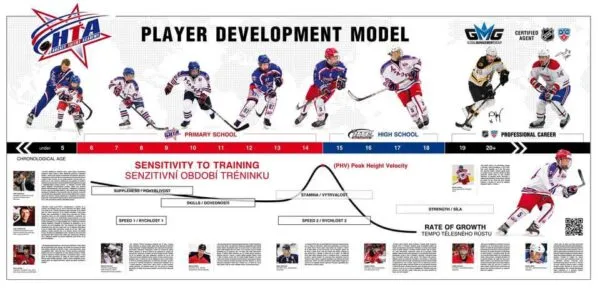 What to focus on when? / Hockey Talent Academy (CZ)
For hockey players, this means that early ice hockey must be supplemented with other sports, otherwise the motor foundation for later elite-level play will be missing. The majority of NHL players specialize only around age 14, however for Hungarian hockey players aspiring to the NHL, early commitment is crucial, because scouts need to identify their talent at the earliest at ages 8-9 and at the latest at ages 12-14, so that Czech-Scandinavian sports gymnasiums and academies, or the preparation for the CHL Import Draft, include the player. Since at ages 15-18 the focus will already be on tactics and strength development, there will be very little time alongside 60-80 games per year to correct individual mistakes and shortcomings.
 Sources:
-
Wormhoudt, R., et al. (2018). The Athletic Skills Model: Optimizing Talent Development Through Movement Education*.
-
Sports Specialization in Young Athletes: Evidence-Based Recommendations.
-
Côté, J., & Hay, J. (2002). Children’s involvement in sport: A developmental perspective. In J. M. Silva & D. E. Stevens (Eds.), Psychological foundations of sport.
-
Ford, P. R., et al. (2009). The Developmental Model of Sport Participation (Journal of Sports Sciences).
-
Sports Specialization in Young Athletes: Evidence-Based Recommendations.
-
Youth Sports Specialization and Its Effect on Professional, Elite, and Olympic Athlete Performance.
-
Disparities in Youth Sports and Barriers to Participation
-
Survey: Low-income kids are 6 times more likely to quit sports due to costs
-
Youth sport: positive and negative impact on young athletes
-
Understanding How Organized Youth Sport May Be Harming Individual Players within the Family Unit: A Literature Review
-
Health Consequences of Youth Sport Specialization
-
Is There Just One Type of Multisport Pathway? A Scoping Review of Multisport Engagement in Early Athlete Development
-
A survey of elite and pre-elite athletes’ perceptions of key support, lifestyle and performance factors
-
The Influence of the Family in the Development of Talent in Sport
-
How To Hockey: Inline / Rollerblading Drills for Hockey Players