

BLOG
Success is Determined in Childhood: Motor Development Ages 6-12
Why do 8-12 year olds learn motor skills faster? The secrets of mirror neurons, implicit learning, and video-based training - and how NHL star movements can be copied at lightning speed.
Imagine a 10-year-old racing across the ice at lightning speed, handling the puck with precision, and instinctively reacting to teammates’ movements. How are children able to acquire such impressive motor skills so early? In this analysis, we explore why children learn faster at this age, which biological processes - such as the function of mirror neurons - support movement copying, and what non-biological factors aid motor development. Special attention is given to the details of implicit learning and movement imitation, as well as the future of video-based training, through which the movements of world stars can be copied as early as age 8-9.
-This article was compiled by the Icehockeypro57 team under the leadership of Attila Orbán, where all the professional background for individual player and goalie development is available-
Why Do 8-12 Year Olds Learn Motor Skills Faster?
This period is the golden age of motor development, when children acquire new movements - such as skating, stick-handling, or quick directional changes - with exceptional speed. Between ages 8-12, children learn motor skills approximately 15-25% faster (The Best Time to Acquire New Skills). For example, a 10-year-old can master a wrist shot or edge technique more quickly because their brain is more flexible, they have fewer ingrained movement patterns, and their nervous system encodes new movements more efficiently.
This rapid learning ability is especially evident in implicit sequential learning, which in hockey is required for understanding passing sequences or the movement of the puck. According to one study, children aged 8-12 learn such patterns approximately 20-30% faster, since their brains detect probabilistic patterns more effectively.
The Biological Reasons Behind Faster Motor Learning
There are numerous biological factors behind the rapid motor learning seen in 8-12 year olds, which are particularly relevant for hockey players whose physical and coordination abilities are developing intensively.
-
Myelination: The coating of nerve cells with myelin sheaths speeds up neural impulses, which is essential for the fast reactions required in hockey, such as tracking the puck. This process peaks between ages 8-12, enabling efficient coordination of movements.
-
Genetic factors: Genes determine approximately 52% of the variance in motor development, influencing muscle development and speed - advantageous in hockey, for instance in the proportion of fast-twitch muscle fibers (Genetic and Environmental Effects on Early Motor Development).
-
Physical growth and maturation: The development of height, muscle mass, and the skeletal system supports the power and stability required for skating. For hockey players, early development of lower-body muscles (e.g., quadriceps, glutes) is critical (Motor Development - an overview).
-
Nervous system maturation: The maturation of the motor cortex, cerebellum, and basal ganglia enables the synchronization of complex movements such as skating and stick-handling.
-
Hormonal influences: Growth hormone promotes muscle development (A review of environmental contributions to childhood motor skills).
-
Sensory development: The maturation of the visual and vestibular systems supports puck tracking and balance on the ice.
-
Mirror neuron system: Active mirror neurons allow for rapid imitation of hockey techniques, especially between ages 8-12 (Mirror Neurons and Motor Learning).
-
Sport-specific physical adaptation: For hockey players, early development of lower-body strength and hand-eye coordination is critical. Edge technique training improves balance, while stick-handling requires fine motor skills (Training Methods of Elite Athletes).
Implicit Learning and the Function of Mirror Neurons
Movement imitation is particularly important in hockey, as players frequently learn by observing coaches, teammates, or videos. The advantage of 8-12 year olds is that their brains have less prior experience, making them more flexibly adaptable to new movements, so compared to adults, a 10-year-old can more quickly imitate an NHL player’s wrist shot from a video. The difference in movement copying speed is approximately 15-25% in favor of the younger age group, especially in implicit tasks.
During implicit learning, an individual acquires new skills or knowledge without consciously understanding or analyzing the learning process. This differs from explicit learning, where the learner consciously follows instructions (e.g., a coach’s explanation of wrist shot technique). Implicit learning is instinctive, often based on observation and repetition, and is especially effective in acquiring motor skills - such as passing, shooting, or skating in hockey. The process is carried out automatically by the brain, supported by synaptic connections and the mirror neuron system.
Mirror neurons are nerve cells that activate both when an individual performs a movement and when they observe a movement performed by another person. These neurons are located in the prefrontal cortex, parietal cortex, and premotor cortex, and are crucial for movement copying in hockey players. The function of mirror neurons peaks between ages 8-12, as the brain’s synaptic plasticity is high, and children intuitively imitate movements without consciously analyzing them (Mirror Neurons and the Evolution of Brain and Language).
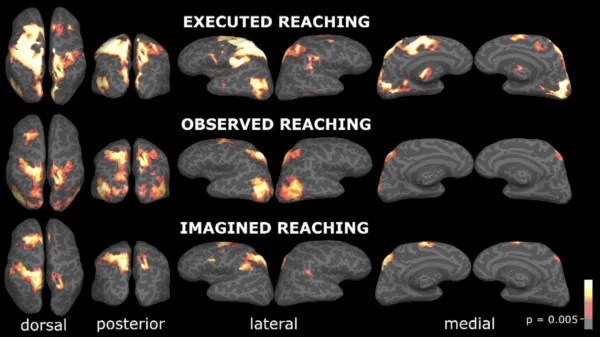 Brain activity for executed, observed, and imagined movement / Source: F. Filimon et al.: NeuroImage 37 (2007) 1315-1328
The function of mirror neurons supports motor learning through three main mechanisms:
Recognition of sequential patterns:
-
During implicit learning, the brain automatically recognizes and encodes probabilistic patterns, such as passing sequences or recurring elements of game situations.
-
Children aged 8-12 learn implicit sequential patterns 20-30% faster than adolescents aged 14-18, because their brains detect probabilistic structures more efficiently (The Best Time to Acquire New Skills).
-
Example: A U10 player unconsciously recognizes during practice that the puck often goes to the right winger in a particular offensive situation, and automatically adjusts their movement accordingly.
Automated movement patterns:
-
During implicit learning, frequently repeated movements become automated, reducing the need for conscious attention. This allows players to react to game situations faster and more effectively.
-
Between ages 8-12, the brain’s synaptic plasticity is high, so motor patterns (e.g., skating technique, shooting motion) are quickly consolidated, providing a lasting advantage (Motor Development). For example, a forward who practices regularly automates the wrist shot, so during a game they can shoot instinctively, without thinking.
Visual-motor (eye-hand) coordination:
-
Implicit learning links visual information (e.g., observing the movement of the puck) with motor commands (e.g., passing), supported by the cerebellum and motor cortex. This is especially important in hockey, where quick reaction time and hand-eye coordination are essential.
-
Between ages 8-12, visuomotor integration is 15-20% more efficient than later on, so children learn to track the puck and pass accurately more quickly. A player unconsciously learns how to time a pass based on a teammate’s movement, without consciously analyzing the situation.
Video-based training, such as Jason Yee’s Train 2.0 method, can revolutionize the motor development of hockey players by leveraging the function of mirror neurons - especially for the 8-12 age group, where implicit learning and movement imitation are strongest. The method uses high-resolution videos and motion analysis software to break down the movements of world stars and teach them step by step to young players. The Train 2.0 approach relies on activating mirror neurons by having children observe the movements of professionals multiple times and then attempt to imitate them. Video training helps players “see the game more slowly,” allowing them to copy complex movements more accurately.
The future of video-based training is particularly promising for the following reasons:
-
Accuracy and accessibility: The movements of world stars are available at any time as digital models, so children can learn the best techniques without meeting them in person.
-
Strengthening implicit learning: Repeated viewing of videos enhances implicit learning, especially for 8-12 year olds who intuitively encode movements.
-
Technological developments: Motion analysis software and VR technology enable real-time comparison of movements, so children can immediately see where they need to improve.
-
Global impact: Platforms like Train 2.0 democratize elite training, making world-class training methods accessible to anyone.
What non-biological factors help young athletes develop faster?
In hockey, ages 6-12 are a decisive period for acquiring the foundations of motor skills such as skating, stick-handling, or shooting, as the brain is exceptionally receptive to learning new movements at this age. While innate abilities such as speed or movement coordination are fundamental, environmental factors - from a supportive family to community spirit - play a key role in allowing a young athlete to realize their potential. These factors - which will be explored in further articles - not only strengthen technical knowledge but also develop motivation, mental resilience, and team spirit, all of which are indispensable for success at the international level.
The family environment is one of the most important driving forces. Families with higher socioeconomic status can more easily provide access to ice rinks, quality coaching, and nutrition. Parents’ enthusiasm and support significantly increases the desire to practice and the development of motor skills (Motor development in school-age children). If older siblings also play hockey, they can inspire younger ones through play and provide movement models for faster development (The Relationship between Social Environmental Factors and Motor Performance).
The hockey education environment is also vital: sport- and hockey-specific physical education programs in schools reinforce athleticism and can often support technical training. Qualified coaches and teachers, as well as small group sizes, can ensure that every child receives individual attention and feedback, which can significantly accelerate development (Environmental Factors Affecting Preschoolers’ Motor Development).
Social connections are also key to motor development. Positive relationships with teammates and friendly competition motivate children to train harder, while the community support of hockey clubs and fans - especially in lower socioeconomic environments - increases commitment. Coaches’ inspirational leadership paired with technical feedback and encouragement is essential for developing children’s confidence and skills. Cooperation between parents and teachers ensures that school and sport activities are aligned, so children can develop in a balanced way without conflicts.
Cultural factors also shape young athletes: societies that love hockey, such as Canada or Scandinavia, provide an inspiring backdrop, but in Hungary the successes of the national team - such as promotion to or remaining in the A group - and the example of NHL stars can also ignite children’s enthusiasm (Fine Motor Skill Development in Young Children).
Other performance-enhancing factors can provide additional help. Specific exercises, such as edge technique or stick-handling drills, directly improve motor skills, while long-term goals - such as making the junior national team - encourage perseverance. Proper nutrition - a diet rich in carbohydrates and protein - supports endurance, and a flexible school schedule ensures recovery. Proficiency in English is an advantage for an international career, while modern technologies such as video analysis and motion analytics refine technique (Training Methods of Elite Athletes).
Psychological factors should not be overlooked either: passion for hockey, the absence of fear of making mistakes, and positive experiences - such as a well-executed shot - increase mental resilience. Psychological training, such as stress management or visualization, prepares children for match pressure, and team spirit strengthens motivation (Elite athletes who willingly let us in on their day to day business). In Hungary, supportive families, enthusiastic communities, and dedicated coaches, together with these factors, can help young hockey players become stars on the ice despite limited opportunities.
Career ❤️ skill development
The period between ages 8-12 is a crucial phase for the technical development of hockey players, as the brain’s neuroplasticity and myelination are at their peak, enabling rapid acquisition of motor skills such as skating, stick-handling, and shooting techniques. At this age, children learn movements 15-25% more efficiently, especially through implicit learning and movement imitation, supported by the active mirror neuron system. The foundations acquired during maximum technical development provide a lasting advantage, as these skills are more difficult to make up for later - 80% of the foundations of skating technique are established by ages 12-14 (Motor Development). For domestic players, this is especially important because, given the limited ice rinks and ice time, the learning potential must be exploited in the early years to keep pace with the international elite.
The advantages of early technical development include the possibility of standing out locally and internationally. Players who dominate between ages 8-12 at regional camps and tournaments (e.g., against Czech, Slovak, Austrian opponents) can attract attention, which can lead to participation in international select teams and tournaments (e.g., Premier Select League, World Selects Invitational, Top 4 Hockey League).
From the perspective of later career development, the technical foundations acquired between ages 8-12 significantly increase the chances of international success. Early technical advantage also builds confidence and motivation, which supports long-term career development, while players can develop with better coaches and teammates in select teams (leveraging the “iron sharpens iron” principle). Early development allows the player to reach the level required for elite junior leagues by ages 12-14, where scouts’ attention is already directed toward the CHL and NHL draft.
Although reaching the NHL draft is quite rare for Hungarian players (most recently János Vas, 2002), early technical development can open alternative pathways to European professional leagues (e.g., Swedish SHL, Austrian ICEHL).
Can technical deficiencies be made up for later?
Early technical skills, such as skating or shooting, are crucial for success, but what happens if a player does not master these perfectly when young? The good news is that technical deficiencies can be improved between ages 13-18 and even later, but this is more time-consuming than in childhood and comes with significant sacrifices. Success depends on the player’s commitment, the quality of training, and the resources available, but the opportunity cost of late development - the lost time and opportunities - is particularly high in our context.
Improving technical skills is possible with targeted training: passing can be made more accurate with static and dynamic drills, while shooting technique can be perfected with video analysis and coaching feedback. Qualified coaches can help correct faulty movements, but making up for technical deficiencies between ages 13-18 requires several additional hours of practice per day.
However, late technical training comes at a high price: while the player is catching up on the basics, the international elite is already developing tactics, ice sense, and physical strength in elite teams and leagues such as the USA National Team Development Program - NTDP (as a reminder: Hungary U19 - USA U17 0-9). These programs maximize development with the following characteristics:
-
Maximum workload: NTDP players participate in strength, tactical, and mental training alongside 2-3 hours of on-ice practice per day, with 5-6 training sessions and games per week. The workload is calibrated to biophysical limits, taking into account age-specific physical capacities (e.g., aerobic endurance, muscle development) to avoid overtraining (Training Methods of Elite Athletes).
-
Personalized development: The NTDP uses motion analysis software, VR-based training, and performance monitoring tools (e.g., heart rate monitors) to optimize technical, tactical, and physical skills. For example, passing or shooting technique is refined using video analysis (Elite athletes are training their eyes).
-
Elite environment: The best coaches, teammates, and opponents accelerate development. NTDP players play 60-80 games per year against elite opponents, which significantly increases game sense and pressure management.
-
Scientific approach: Biophysical limits (e.g., muscle recovery, energy use) are optimized based on sports science research, for example by leveraging the hormonal changes of puberty in strength training (A review of environmental contributions to childhood motor skills).
In hockey, the foundations of success are truly determined in childhood, when the acquisition of motor skills is fastest and most efficient. In this “golden age,” the brain’s neuroplasticity and biological processes - such as myelination and the function of mirror neurons - allow children to learn new movements at lightning speed. Without the technical foundations acquired through implicit learning and movement imitation, reaching the international elite is virtually unimaginable. However, development does not stop at age 12: during the period from ages 13-18, technical deficiencies can still be made up for, although this requires more time and effort, which is why - for Hungarian hockey players, where international visibility is limited - it is especially important to make the most of the early years.