


BLOG
The Key Role of NHL Scouts in Talent Identification
Little is said in Hungary about the role of scouts, yet they often decide the outcome of 15 years of hard work in just a few sentences. Using the example of NHL teams, we present the qualities they look for and the entire scouting process.
Little is said about the role and responsibilities of scouts, yet they often determine the outcome of 15 years of hard work in just a few sentences. Using the example of NHL teams, we present the qualities they look for in players and the entire scouting process - from beginning to selection. This will be a very long article, but it allows us to give players, coaches, and parents a complete picture.
-This article was compiled by the Icehockeypro57 team under the leadership of Attila Orbán, where all the professional background for individual player and goaltender development is available-
Let’s start with a summary:
-
The duties of NHL scouts include identifying talents, observing games, and preparing for the draft.
-
They watch junior leagues (e.g. CHL), the NCAA, top European leagues (e.g. SHL), and international tournaments.
-
A report contains the player’s skills, character, and potential role in the NHL (stars, two-way forwards, power forwards, defensive defensemen, offensive defensemen, and grinders), typically one to two pages in length.
-
For a top player expected in the early rounds of the draft, approximately 10-20 evaluations are likely produced before draft day, though no exact number is known.
-
Individual skills are the primary focus, but team context is also taken into account, such as the player’s role on the team.
-
Scouts are likely distributed geographically in proportion to the number and quality of potential players - more in North America, fewer in Europe (primarily in Swedish-Finnish, Czech, and Russian regions).
-
In Europe, scouts primarily look for players with offensive potential, especially goal scorers.
-
Scouting generally begins at age 13-14, though exceptionally talented players may be noticed as early as 10-11.
-
Reports often include how the player performs against the opponent’s best players, which is an important part of the team context.
In the NHL, 32 teams have approximately 550+ scouts combined covering amateurs and professionals - an average of 17 per team. They generally work in the background but play a key role in shaping the franchise’s future. Their duties include identifying talent, watching live games, producing video analyses, and writing detailed reports on potential players. Their outlook is forward-looking: they consider where their own team currently stands and what kind of talent will be needed in 2, 5, or 10 years. For example, they analyze whether large contracts are approaching that could be replaced by younger players, or what the goaltending free-agent market might look like in the future.
Scouts fall into two main categories: those who work with amateur players and those who work with professionals. Amateur scouts look for draftable players, while professional scouts evaluate current NHL and AHL players as well as free agents. For example, the Seattle Kraken’s professional scouting staff reviews every other team’s players under professional contract in May and prepares reports on potential free agents or trades (Sportsnet: Inside the player evaluation process).
Before we dive into the details - who exactly are they looking for?
In the NHL, a player’s role defines their function on the ice and often reflects their personality or mentality as well. Understanding the main roles is important because a player’s potential role largely determines their opportunities.
Star Players:
Players with exceptional abilities who are the team’s offensive engines, most often playing on the first or second line. They are the top point producers and key figures in games.
-
Personality: Confident, calm under pressure, natural leaders, often introverted off the ice.
-
Estimated number: 2-4 players per team.
A typical NHL team has 1-3 star forwards (e.g. Connor McDavid, Auston Matthews) and possibly 1 star defenseman (e.g. Cale Makar). The number of stars depends on the team’s strength - elite teams (e.g. Edmonton Oilers) may have more, weaker teams fewer.
Two-Way Forwards:
Strong both offensively and defensively, often crucial in tight games. They typically play on the second or third line and spend a lot of time on the penalty kill.
-
Personality: Humble, hard-working, quiet leaders.
-
Estimated number: 3-5 players per team.
Of the 12 forwards, typically 3-5 belong to this category, especially in the middle lines. They are the team’s “backbone,” providing a balanced game.
Power Forwards:
Physical players who are strong in front of the net, dominate in board battles, and frequently score from close range. They often play on the lower lines as well.
-
Personality: Combative, energetic, extroverted, sometimes provocative.
-
Estimated number: 2-4 players per team.
Among forwards, typically 2-4 players fit this profile, especially on the second, third, or fourth line. Physical play is crucial in the NHL, but not every team builds around this many power forwards.
Defensive Defensemen:
The pillars of the defense, neutralizing the opponent’s stars, blocking shots, and playing key roles on the penalty kill. They are less offensively oriented.
-
Personality: Self-sacrificing, hard-working, modest.
-
Estimated number: 3-4 players per team.
Of the 7 defensemen, typically 3-4 belong to this category, especially in the second and third pairings. Defensive defensemen provide stability.
Offensive Defensemen:
Creative, fast defensemen who join the attack, accumulate many points, and play key roles on the power play.
-
Personality: Creative, risk-taking, confident.
-
Estimated number: 1-3 players per team.
Typically only 1-2 defensemen per team fall into this category, as the offensive role carries risk. Elite teams (e.g. Colorado Avalanche) may have more of these players.
Grinders and Role Players:
Hard-working players who play on the lower lines. Characterized by physical play, defensive responsibility, and an energetic presence.
-
Personality: Team-oriented, unselfish, persistent.
-
Estimated number: 4-6 players per team.
Of the 12 forwards, typically 4-6 belong to this category, mainly on the third and fourth lines. These are the “grinders” who do the dirty work.
The exact numbers for each role depend on the team’s strategy and playing style. For example, the Boston Bruins build on more defensive defensemen and power forwards, while the Colorado Avalanche places the emphasis on offensive defensemen and star players.
Profile General attributes Role-specific attributes Examples
Star Players Fast skating, goal scoring, passing, high hockey IQ If sniper: accurate shot; if playmaker: vision; if all-around: excellent in everything Connor McDavid, Auston Matthews
Two-Way Forwards Fast skating, endurance, strong defense, offensive capabilities Defensive positioning, poke check, stick lift, reliability Patrice Bergeron, Anze Kopitar
Power Forwards Large frame, physical strength, goal scoring Battle in front of the net, board play, scoring from close range Brady Tkachuk, Tom Wilson
Defensive Defensemen Strength, fast skating, shot blocking Positioning, neutralizing opponents, puck retrieval Chris Tanev, Jacob Trouba
Offensive Defensemen Fast skating, passing, goal scoring Joining the attack, creativity, risk-taking Cale Makar, Quinn Hughes
Grinders and Role Players Endurance, physical strength, defense Physical play, special teams role, work rate Zach Hyman, Nic Dowd
The process of talent identification
NHL scouts play a key role in finding talent, and the scouting process often spans multiple years to identify potential NHL players. Talent identification is a complex process that includes live observations, video analysis, analytics, and evaluation of the player’s environment.
-
Live and video observation: Scouts spend countless hours analyzing games, both live and on video. At live games, they typically focus on 1-2 players per game, taking detailed notes on their performance. For video scouting, they use tools such as InStat and SportContract to efficiently analyze player-specific shifts.
-
Data and statistics: Modern scouting uses advanced statistics such as Corsi or Fenwick metrics and data management systems to support their observations. This includes performance metrics such as points per game or shooting percentage to identify trends and confirm observations.
-
Networking and information gathering: Scouts often connect with former coaches, teammates, and other scouts to build a complete picture of a player’s character, work ethic, and potential. This includes observing family and friends and conducting character assessments through phone calls.
What do they look for in a player?
A player report provides a detailed analysis of the player’s skills, character, and potential NHL role. It typically includes:
-
Skills: Speed, shot, passing, defense, physical strength, and performance in special situations (e.g. power play, penalty kill).
-
Character: Work ethic, team spirit, performance under pressure, and behavior off the ice.
-
Potential role: For example, forward (top-6 or bottom-6), defensive player (offensive or defensive), or goaltender (starter or backup).
-
Trends and development: How the player has developed over the past seasons, and what long-term potential they possess.
Reports are typically 1-2 pages long, containing both ratings (e.g. letter grades A+, A, B, C or numerical scores) and written descriptions that include observations about the player’s strengths and areas for improvement. Scouts look for a range of physical, technical, and mental attributes that indicate a player’s potential in the NHL.
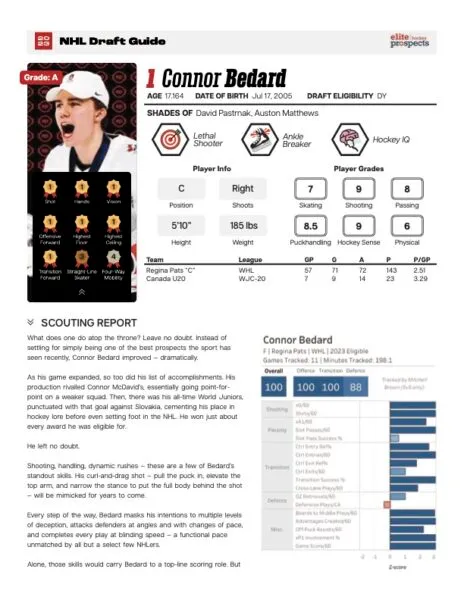 Connor Bedard’s profile on Elite Prospects / Source: eliteprospects.com
Skills categories
- Skating
Explosiveness: First-step acceleration, measuring the ability to burst into motion quickly.
-
Separation: Speed in open ice with or without the puck - the ability to create distance from opponents.
-
Agility: Tight turns, pivots, edge changes, and maneuverability in tight spaces. Quick decision-making and execution.
-
Drive: The strength and efficiency of the skating technique.
-
Stride length: The length of skating strides, which affects the maintenance of speed.
-
Knee position: The position of the knee during skating, affecting balance and power.
-
Y-angle: Ankle mobility.
-
Shin-angle: The angle formed by the foot and shin.
-
Stops/Starts: The ability to make sudden stops and quick restarts.
-
Edge work: The use of skate edges in turns and direction changes.
-
Forward/Backward skating difference: The difference in skating speed and efficiency between forward and backward movement.
-
Transitions: The smoothness of direction and movement changes.
-
Pivots: The ability to execute quick turns and position changes.
-
Leg strength: The power of the lower body, which is the foundation of skating performance.
-
Hockey sense
Reading/Reacting: Reading the game and reacting quickly to situations, such as positioning and understanding the flow of play.
-
Game management: Choosing simple or complex plays, managing the tempo and rhythm of the game.
-
Three-zone awareness:
Pinch: Actively stepping up in the offensive zone to maintain possession or apply pressure.
-
Stay Home: Maintaining a safe defensive position to avoid risk.
-
Gap Up: Closing the gap on the opposing puck carrier, especially in the neutral zone.
-
Man Coverage: Following and neutralizing the opponent’s key players, especially in the defensive zone.
-
Positional play: Finding the right position on the ice in offensive and defensive situations.
-
Transition Ability: Quickly switching from offense to defense or vice versa. Statistically, the probability of scoring goals increases dramatically at transitions, making it critical - either through outstanding performance or through frequent errors.
-
Risk assessment: The player’s ability to balance risks and rewards.
-
Game reading: Anticipating the flow of play and making proactive decisions.
-
Support of teammates: Helping teammates through positioning and communication.
-
Proactive vs. Reactive approach: Initiating the game versus reacting to situations.
-
Covering for teammates: Taking over a teammate’s position when necessary.
-
Freelancing: Making creative decisions in unstructured situations.
-
Scouting innovation: Applying novel solutions in the game.
-
Game Death: Slowing down or interrupting play for defensive purposes.
-
Pinching Decisions: Timing and correct execution of offensive zone entries and forechecking.
-
Safe vs. offensive risks: Weighing risky offensive moves.
-
Playmaking: Creating goal-scoring opportunities for teammates.
-
Smart passing: Selecting accurate and efficient passes.
-
Using linemates: Exploiting the strengths of teammates.
-
Open areas: Identifying open space on the ice.
-
Stealth: Approaching opponents undetected or positioning quietly.
-
Finding/Filling holes: Exploiting or reinforcing weak points in the defense.
-
Losing defenders: Deking or losing defensive opponents.
-
Coachability: Understanding and applying coaching instructions.
-
Physicality
Hard hitting: Delivering effective body checks in open ice or along the boards.
-
Strong pressure: Impeding the opponent’s progress with physical presence.
-
Energy/Limited physicality: Active movement, using speed instead of checks, and endurance throughout the game.
-
Offense
Goal scorer: The ability to score goals in various situations, such as with accurate shots.
-
Playmaker/Distributor: Creating scoring opportunities with simple or complex passes.
-
Power play: Effectiveness on the power play, such as passing or shooting.
-
Defense
Play without the puck: Effort to backcheck and positioning without the puck. Especially important, since 95-98% of ice time is spent without the puck.
-
D-Zone Starts: Reliability on defensive zone faceoffs.
-
Match Up/Shutdown: The ability to neutralize the opponent’s best players.
-
Penalty kill: Effectiveness while shorthanded, such as blocking shots or rotations.
-
Skills
Puck handling: Controlling the puck in tight spaces and under pressure.
-
Hand speed: Quick and precise puck movement.
-
Shot generation: The ability to create shooting opportunities.
-
Quick-release shooting spot: Executing unexpected and quick shots.
-
Stick preparation: Properly positioning the puck for a shot or pass.
-
Special moves: Using unique technical tricks.
-
Evasiveness: Deking or evading opponents.
-
Speed
Tempo: The pace of play dictated by the player.
-
Urgency: The ability to play with intensity and react quickly.
-
Skills at different speeds: The ability to apply skills at various tempos.
-
Setting the tempo: Influencing the rhythm of the game.
-
Changing tempo: Adjusting speed to match game situations.
-
Maintaining tempo in the game: Consistently sustaining speed.
-
Forcing tempo changes on opponents: Disrupting the opponent’s pace.
-
Maintaining tempo during transitions: Sustaining speed when switching from offense to defense.
-
Projections
Role at the NHL level: The player’s expected position and role in the NHL, such as top-6 forward, shutdown defenseman, or depth player.
Long-term projection and contextual fit
-
Development curves: Scouts take into account a player’s age and physical development when projecting their long-term potential.
-
Team dynamic fit: How a player might fit into a specific team’s system, culture, and needs. This includes aligning their potential role (e.g. top-6 forward, shutdown defenseman) and skills with the team’s playing style.
What do they look for / watch for?
Various scouts have shared their perspectives on what they look for in prospects:
-
Will Scouching: Pace, speed, skill, awareness, space manipulation, and handling pressure.
-
Justin Froese: Players who force opponents to solve problems and can adapt.
-
Sam McGilligan: Practicality, layering of tools, ice mapping, and space management.
-
Josh Bell: Use of space, creating space, and awareness.
-
Josh Tessler: Compete level, creativity, deception, and position-specific attributes.
-
Riley Dudar: Ice scanning and extending puck possession.
-
Blair Courchene: Response to negative plays, decision-making, and situation manipulation.
-
Jared Brown: Competitiveness, problem-solving, and linking plays/passes together.
-
Chris Moulton: Character, consistency, compete level, creativity, leadership, hockey sense, self-assessment, and skating.
-
Mikael Holm: Transitions, offensive and defensive setups, and stick handling.
Overall, NHL scouts identify talent through thorough observation, analytics, and analysis of the player’s environment. They look for key attributes such as skating speed, hockey sense, compete level, and shooting technique, as well as personality traits such as leadership and composure. While the process is thorough, predicting future success remains a challenge, but the combination of traditional scouting and modern tools helps uncover the next generation of stars.
Geographic distribution and leagues observed
The geographic distribution of scouts is proportional to the number and quality of potential players. Research suggests that scouts primarily watch junior leagues such as the Canadian Hockey League (CHL), the NCAA, and European leagues such as the Swedish Hockey League (SHL). International tournaments such as the World Championships, U18 and U20 World Championships are also important for assessing talent.
For example, in North America, where the CHL and NCAA produce strong talents, there are certainly more scouts than in, say, Asia, where hockey is less developed. In Europe, particularly in Sweden and Finland, where the SHL and Liiga maintain a high standard, significant scout presence is also observed. In Central Europe, the Czech-Slovak region has the nearest NHL scouts (5-10% of drafted players can be traced back to this region). Scouts consider not only individual players but also the overall level of the leagues, such as the differences between the CHL and SHL, which influences how many scouts work in a given region.
-
Junior leagues: Canadian Hockey League (CHL), which includes the Ontario Hockey League (OHL), Quebec Major Junior Hockey League (QMJHL), and Western Hockey League (WHL).
-
College league: National Collegiate Athletic Association (NCAA), particularly in the United States.
-
European leagues: Swedish Hockey League (SHL), Finnish Liiga, and other European leagues that produce strong talents.
-
International tournaments: World Championships, U18 and U20 World Championships, and the Olympic Games, which provide opportunities to observe young players.
Who do they look for in Europe?
NHL teams in Europe look for players with outstanding skills, especially in skating, passing, and goal scoring.
A fact mentioned by multiple scouts is that in the case of European players, they look for a “shooting first” goal-scorer mentality - though they do not focus exclusively on goal scorers. Research shows that playmaking centers - like Jari Kurri - are also particularly valued.
When does scouting begin?
Now that we know the attributes scouts look for, let’s look at the practical side: when and how does the process begin.
Players are generally first scouted starting at age 13-14, although exceptionally talented players may be noticed even earlier, at age 10-11. This is especially true for players who perform outstandingly - for example, scoring many goals or dominating their age group. Sidney Crosby was noticed at age 10 when he scored 159 goals in 55 games for his local youth club (Biography.com: Sidney Crosby).
For a top player expected to be selected in the early rounds of the draft, multiple evaluations are likely produced. Research suggests an average of 10-20 evaluations may be compiled on such a player before the draft, given that multiple scouts see them play in different leagues and tournaments, each of whom may write a report. According to Sportsnet, top prospects such as a U20 World Championship participant may be observed in multiple leagues, with each observation potentially resulting in a new report.
The following table summarizes the scouting age groups and related events:
Age Observation Note
10-11 years Informal observation, outstanding performance E.g. Crosby: 159 goals in 55 games
13-14 years Initial scouting, monitoring of junior leagues Exceptionally talented players become known
15 years Formal scouting, draft preparation CHL, USHL draft for 15-16 year olds
16-17 years Intensive scouting, NHL draft preparation NHL draft at age 18
The age of 13-14 partly helps scouts predict adult performance because around the time of the growth peak, a player’s fundamental physical and technical skills become more visible, yet development has not yet fully concluded. The following factors explain this relationship:
-
Stability of physical attributes: After the growth peak, a player’s body size and fundamental physical traits (e.g. height, build) become relatively more stable, allowing scouts to better estimate whether a player can meet the NHL’s physical demands. For example, a 14-year-old player who is already strong and fast is likely to retain these qualities as an adult, although strength training may bring further improvement ([Ford et al., 2011, The Role of Growth and Maturation in Talent Identification]).
-
Foundations of technical skills: Much of the fine-motor skills such as puck handling or shooting technique are established by ages 12-14, since these skills are most sensitive to development in the earlier years (ages 6-12). While technical refinement is possible later, scouts can already see at this stage whether a player has the fundamentals needed for the NHL ([Balyi & Hamilton, 2004, Long-Term Athlete Development]).
-
Uncertainty of mental and tactical development: Although physical and technical skills become more apparent by age 13-14, mental and tactical skills - such as hockey sense, decision-making, or handling pressure - can still develop significantly later. This means that accurately predicting adult performance remains a challenge, and scouts conduct long-term observation to track these aspects (Hockey’s Arsenal: What Do Hockey Scouts Look For in a Player?).
-
Advantage of early maturation: Early-maturing players, who reach their growth peak earlier (e.g. at ages 12-13), often dominate at the 13-14 age group because they are bigger, stronger, and faster than their peers. This may represent a temporary advantage that scouts notice, but research shows that late-maturing players can also reach the NHL if they possess the right skills - for example, hockey sense or a competitive drive (Sports Illustrated: NHL Draft: How Scouts Pick Out the Top Prospects).
To err is human - why prediction is so difficult
Despite the fact that ages 13-14 help scouts identify fundamental skills, predicting adult performance remains difficult for the following reasons:
-
Late development: Some players who mature physically later (e.g. at ages 15-16) do not stand out at the 13-14 age group but show significant development later. For example, smaller-framed players like Johnny Gaudreau can still succeed later if they possess exceptional skills (Sports Illustrated: NHL Draft: How Scouts Pick Out the Top Prospects).
-
Mental and tactical development: Mental skills crucial in hockey, such as hockey sense or handling pressure, often only fully develop at ages 16-18, meaning that observations made at ages 13-14 do not necessarily reflect the ultimate potential (Hockey’s Arsenal: What Do Hockey Scouts Look For in a Player?).
-
External factors: A player’s development is influenced by numerous factors such as the quality of coaching, injuries, motivation, and family background. These are difficult to predict at age 13-14, which is why scouts conduct long-term observation (The Athletic: NHL Draft Scouting Guide 2024).
The future lies in objective evaluation - NHL Edge
Electronic motion-acceleration tracking systems such as NHL Edge are bringing significant change to hockey scouting by providing accurate, real-time data on player movement. These systems supply objective metrics - such as skating speed, acceleration rate, and movement patterns - that allow scouts and analysts to move beyond traditional, subjective assessment.
-
Objective data: In traditional scouting, scouts often relied on visual impressions, such as “this player looks fast.” Systems like NHL Edge provide specific numbers: for example, “the player’s maximum speed is 25 mph, and they accelerate from 0 to 20 mph in 2 seconds.” This enables more accurate and measurable performance evaluation.
-
Detailed analysis: The technology allows for detailed mapping of player movement, such as the speed of direction changes, acceleration patterns, or energy efficiency, opening new dimensions in performance analysis.
-
Real-time insight: Data is immediately available, allowing coaches and scouts to react quickly to player performance, even mid-game.
Digitalization is making scouting data-driven and scientific, reducing the role of subjectivity and enabling more accurate assessment and comparison of player abilities - so now you just have to be better than the rest :)
 Main sources:
-
NHL player archetype analysis
-
Hockey player archetypes in detail
-
NHL Draft Scouting Guide 2024
-
What Do Hockey Scouts Look For in a Player?
-
NHL Draft: How Scouts Pick Out the Top Prospects
-
Balyi, I., & Hamilton, A. (2004). Long-Term Athlete Development: Trainability in Childhood and Adolescence*. Olympic Coach Magazine.
-
Ford, P., et al. (2011). The Role of Growth and Maturation in Talent Identification and Selection in Sport. Sports Medicine, 41(8), 677-695.
-
HFBoards: How early does scouting begin?
-
Sportsmanist: At what age do hockey players get scouted?
-
NCSA Sports: 2024-25 NCAA Hockey Recruiting Rules and Calendar
-
Biography.com: Sidney Crosby
-
The Athletic: NHL Draft Scouting Guide 2024
-
Hockey’s Arsenal: What Do Hockey Scouts Look For in a Player?
-
Sports Illustrated: NHL Draft: How Scouts Pick Out the Top Prospects