

BLOG
The Psychology of Creative Development (Part 1)
How does creativity develop in ice hockey? Through the theories of Amabile, Csíkszentmihályi and Guilford, we explore why nurturing creative thinking at different ages is crucial - and how coaches and parents can support young players along the way.
Imagine a young hockey player who unexpectedly dekes out an opponent, invents a new passing solution, or fires a blast from an seemingly impossible angle. That’s creativity - the ability to come up with new ideas and respond flexibly to the unpredictable situations the game throws at you. In ice hockey, creativity is crucial because it helps players make quick, surprising decisions and solve difficult situations.
This article was compiled by the Icehockeypro57 team under the guidance of Attila Orbán, where every professional resource for individual player and goaltender development is available.
In this piece we tour the theoretical models of creativity; in our next article we’ll work through the practical solutions and challenges.
For the European players NHL scouts covet, creativity is especially vital. The European style of play - built on technical and tactical skills, game intelligence, and creative problem-solving - provides a huge advantage in the North American league thanks to the smaller ice surface and faster tempo.
Theoretical Models of Creativity
The study of creativity has been a fascinating topic in psychology for decades, since this ability is crucial for innovation, problem-solving, and personal growth. Researchers have developed numerous theoretical models to understand how creativity emerges and develops, particularly in dynamic environments like ice hockey. Below we present three landmark models: Amabile’s componential model, Csíkszentmihályi’s systems model, and Guilford’s divergent thinking model.
Amabile’s Componential Model: The Three Pillars of Creativity
According to Teresa Amabile’s model, first published in 1983 and updated in 2019, creativity is built from three core components: domain-relevant skills, creative thinking skills, and intrinsic motivation.
-
Domain-relevant skills are the collection of technical skills and tactical knowledge that form the foundation of creative activity. In ice hockey, this means a player must have mastery of the movements - skating, puck-handling, passing, and shooting. A player who is confident in puck control can more easily invent new dekes because they don’t have to concentrate on technical execution.
-
Creative thinking skills encompass divergent thinking and problem-solving ability, which allow a player to come up with new, innovative ideas - such as an unusual shooting deke or a unique deke-pass combination.
-
Intrinsic motivation is key: creativity flourishes when a player enjoys the game and isn’t playing for external rewards - such as praise or trophies.
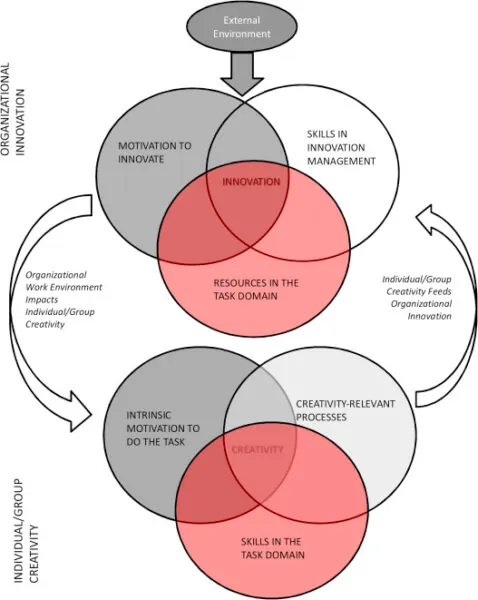 Amabile’s componential model // sciencedirect.com
In ice hockey, a creative attack is born when these three elements align. For example, a player who skates confidently at high speed (domain knowledge), spots a passing lane the opponent can’t read (creative thinking), and is driven by passion for the game to take a risk (intrinsic motivation) may be able to develop a new solution for scoring.
Amabile and Pratt’s 2019 meta-analysis found that positive feedback and a supportive environment - such as an encouraging word from a coach or recognition from teammates - significantly increase intrinsic motivation, and thus creativity. Adults must praise children’s experiments (even when a new move doesn’t work the first time) to sustain intrinsic motivation and encourage creative thinking.
Csíkszentmihályi’s Systems Model: The Role of Individual, Domain, and Field
According to the systems model developed in 1996 by Mihály Csíkszentmihályi, the world-renowned Hungarian-American psychologist, creativity is not just an individual’s ability but also the product of the social and cultural environment. The model identifies three key elements: the individual, the domain, and the field.
-
The individual contributes their own skills, knowledge, and motivation to creativity. In ice hockey, this means a player’s technical knowledge, game intelligence, and intrinsic motivation.
-
The domain represents the rules, techniques, and culture of ice hockey, which frames creative expression. For example, playing with three-metre sticks would be a creative solution - but the rules don’t allow it.
-
The field encompasses coaches, teammates, parents, and fans, who evaluate and support creative ideas. The field’s supportive or dismissive attitude determines whether a player feels safe experimenting. If coaches or parents don’t support creative but risky shots (which carry a higher chance of mistakes) and prefer safe, error-free passes instead, it can train players out of creative shooting. This effect is especially pronounced in younger age groups (e.g. 6-12 year olds), where players are still more sensitive to external feedback.
A player truly becomes creative when these elements are in harmony. Community support is especially important for young players who are still learning the game, as an encouraging word from a coach or recognition from teammates builds their confidence and encourages them to dare to experiment with new ideas.
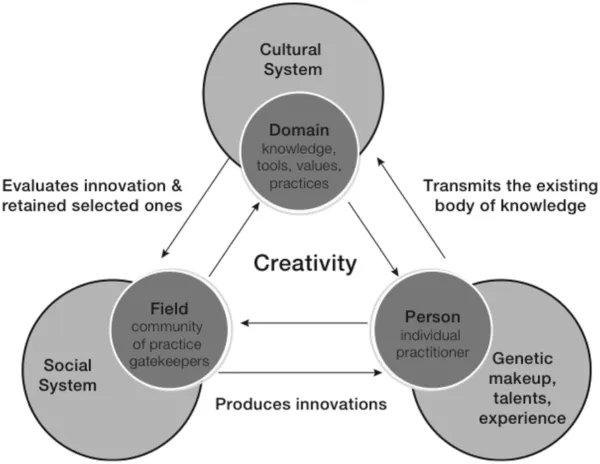 Csíkszentmihályi’s systems model // researchgate.net
Sports psychology research, such as Weinberg and Gould (2019), shows that young athletes are especially sensitive to fear of making mistakes, since their confidence is still forming. If a coach or parent reacts negatively to a missed shot (e.g. “Why didn’t you pass?!”), it can trigger anxiety in the player, reducing their willingness to try further creative solutions. Darryl Belfry explicitly emphasises that the coaching environment must allow mistakes so players can experiment boldly.
Imagine a 10-year-old hockey player who misses a saucer pass because they wanted to try in a game what they’d been practising in training. If the coach says “That was stupid - why didn’t you make the simple pass?”, the player may feel anxious and next time will likely choose the safe option, even if it’s less effective. By contrast, supportive feedback (e.g. “Good idea - try to make it more precise next time!”) encourages experimentation and maintains creativity.
Anxiety and fear of failure inhibit the flow state that is particularly conducive to creativity - when a player is completely absorbed in the game, giving full attention to the moment and focusing only on play.
Guilford’s Divergent Thinking Model: The Engine of Creativity
According to J.P. Guilford’s divergent thinking model, formulated in 1950, the basis of creativity is the ability to find multiple solutions to a problem. He identified four aspects of divergent thinking: fluency, flexibility, originality, and elaboration.
-
Fluency refers to the ability to generate many ideas - for example, a hockey player notices multiple passing and shooting options in a tight situation.
-
Flexibility means a player can come up with different types of ideas - for example, choosing between a deke, a pass, or a shot.
-
Originality means creating unique, new ideas - for example, a deke the opponent doesn’t anticipate.
-
Finally, elaboration refers to working out ideas in detail - for example, executing a deke-pass-shot combination precisely.
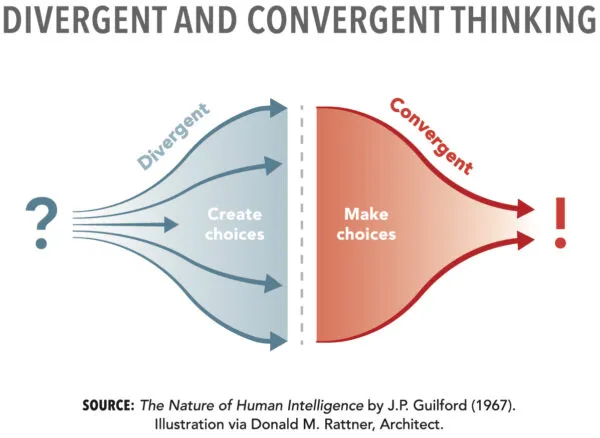 Divergent thinking // donaldrattner.com
In ice hockey, divergent thinking allows a player to quickly find multiple solutions to a situation. For example, against a tight defence, a player might notice several passing lanes, choose an unexpected deke, or work out a new combination that leads to a goal. This flexible thinking is especially important given hockey’s pace, where players must make decisions in fractions of a second.
Acar and Runco’s 2020 research found that practising divergent thinking - for example with “what if?” questions that encourage children to imagine new possibilities - significantly increases creativity. Coaches and parents can encourage children to think after training or at home about how they might solve a game situation differently - for example: “What if you made a quick pass instead of a deke?” Video analysis and simulation exercises (e.g. small-area games) are particularly effective for developing divergent thinking, as they encourage players to try new ideas in realistic situations.
Together, these models help coaches and parents support the creative development of young ice hockey players - through positive feedback, playful training, and creating an environment that encourages experimentation and the flow state. Applied to ice hockey, these theories help children become not just skilful players but creative problem-solvers on and off the ice.
If You Can’t Do It, Imagining It Won’t Help
Creativity ultimately requires the practical realisation of thoughts and ideas, which in ice hockey presupposes technical skills. For example, a player might imagine a shot to the short side from an unexpected angle, but if they can’t execute it precisely, the idea becomes just a funny attempt. Darryl Belfry also emphasises that technical excellence frees up cognitive capacity, enabling players to make creative decisions under pressure.
Acquiring an early technical toolkit is necessary for becoming a creative player because:
-
Automation: Automating technical skills (through myelination) allows players to skate with their heads up and focus on reading game situations and making creative decisions.
-
Confidence: Early technical knowledge builds confidence, which encourages risky, creative attempts.
-
Cognitive capacity: Automating technical skills frees up cognitive resources that players can use to develop new strategies (Amabile’s and Guilford’s models).
Creativity Development Framework
The Creativity Development Framework is a developmental model that identifies five stages in the development of creativity in children and adolescents. This model is particularly relevant in ice hockey because it helps us understand how creativity emerges at different ages and how we can support children at each stage.
Stage 1: Beginner (Ages 2-6)
Creative development begins in the very youngest age group, when children are just getting acquainted with ice hockey. The beginner stage is about laying the foundations of creativity through playful, spontaneous exploration and mastering basic movements. At this age, children instinctively experiment and try out skating, puck-striking, or stick-handling, but their attentional capacity is still limited and their technical skills undeveloped. For this reason, training must be fun and playful to maintain children’s interest and joy in the game.
Training in this stage focuses on enjoyable, open-ended activities - such as mini small-area games where children can freely try out skating or puck-striking without strict rules or expectations. If a 4-year-old accidentally hits the puck in a new way during practice, they should be praised immediately: “Great try, keep going!” This positive feedback encourages the child to keep experimenting.
According to Runco (2014), in early childhood, an unstructured, playful environment is crucial for establishing the foundations of creativity, because it allows children to explore movements and ideas instinctively without fear of making mistakes holding them back.
Stage 2: Explorer (Ages 7-9)
In the explorer stage, creative development reaches a new level as children begin to understand the game’s rules and technical fundamentals. At this age, creativity manifests in the conscious exploration of movements and simple strategies. The goal is for players to experiment confidently with new moves.
Small-area games - such as 3v3 matches - are particularly ideal because they take place in tight spaces, so children frequently face decision-making situations and get opportunities to experiment.
According to Memmert (2015), children’s creative thinking develops best at ages 7-9 when they take part in training sessions that allow free experimentation and maintain the joy of play. Small-area games not only develop technical skills but also build children’s confidence.
Stage 3: Illuminated (Ages 10-12)
In the illuminated stage, creative development takes a significant step forward as children begin to connect their technical skills with game intelligence. At this age, players can already make simpler creative decisions and consciously try to find new solutions, such as transitions between movements.
Exercises that encourage creative decisions and quick transitions are valuable here, particularly through the Constraints-Led Approach (CLA). Introducing visualisation techniques is also effective, where children mentally rehearse new combinations.
According to Roca et al. (2020), the development of game intelligence and movement fluency - the ability to make smooth transitions between movements - is crucial for creativity in the 10-12 age group.
Stage 4: Creative (Ages 13-15)
In the creative stage, adolescents can already make complex creative decisions and develop new, unique strategies. At this age, children’s technical skills and game intelligence allow them to consciously apply their creativity. They not only execute learned moves but actively seek innovative solutions - such as new deke-pass-shot combinations.
Coaches can organise training sessions that simulate real match situations, such as 5v5 games. Introducing “what if?” questions can also develop creative thinking. Positive self-reflection is also an important tool, where children think through what they learned from a new attempt.
Biological maturation - the Peak Height Velocity (PHV) - has a significant effect in this age group, so a supportive environment and positive feedback are crucial for creativity to flourish in adolescence.
Stage 5: Outstanding (Ages 16+)
In the outstanding stage, creative development reaches its peak, as young adults can now demonstrate high-level creativity, develop unique strategies, and take on leadership roles in the team. At this age, a player’s creativity is based on the integration of technical knowledge, game intelligence, and problem-solving ability.
Coaches can set challenges that require high-level creativity - such as breaking through a tight defence or developing new attacking systems. Visualisation techniques remain important, and maintaining daily technical practice is also essential.
Research suggests that outstanding creativity in this age group also depends on community recognition. According to Csíkszentmihályi (1996), creativity fully blossoms when a player not only relies on their own skills and ideas but also receives support from coaches, teammates, and fans.
| Stage | Age | Creative characteristics | Ice hockey practice | Coach/parent support |
|---|---|---|---|---|
| Beginner | 2-6 | Spontaneous experimentation, discovering basic movements | Mini small-area games, free skating | Playful environment, praise |
| Explorer | 7-9 | Trying simple movements and strategies | 3v3 games, practising basic transitions | Encouragement, simple instructions |
| Illuminated | 10-12 | Creative decisions, simple transitions | CLA-based exercises, visualisation | Positive feedback, supporting experimentation |
| Creative | 13-15 | Complex strategies, new combinations | 5v5 games, “what if?” questions | Encouraging independent thinking |
| Outstanding | 16+ | High-level creativity, leadership role | Real match situations, new strategies | Recognition, providing challenges |
The Effect of Background Noise on Creativity
Psychologists have been studying the relationship between creativity and background noise for decades, examining how different noise levels and types affect cognitive performance - especially divergent thinking, which is the basis of creativity.
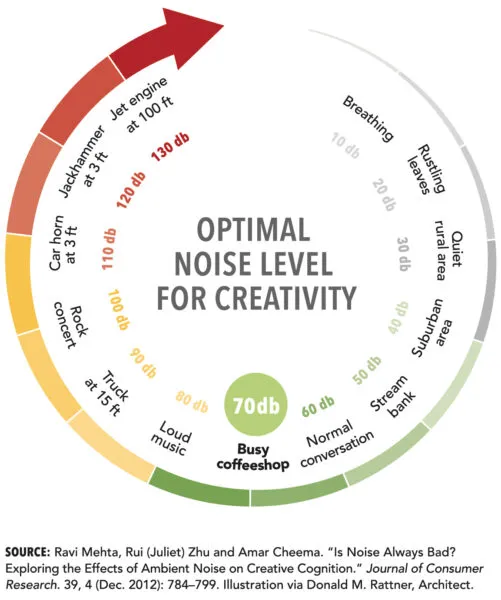 The optimal noise level for creative work // donaldrattner.com
According to Mehta’s 2012 research, moderate background noise - around 70 decibels, equivalent to a busy café or lively restaurant - can promote creative thinking by stimulating abstract thought through mild distraction. This level is enough to divert attention from routine thinking without being excessive or causing stress and cognitive overload. By contrast, an overly quiet environment - such as a library’s 30-40 decibels - can limit inspiration by lacking the minimum stimulation that supports generating new ideas. The type of noise matters too: varied ambient noise is more favourable for creativity than steady, monotonous white noise (Skillicorn, 2016).
In the ice hockey context, music plays a special role - not just for creativity but also for motor development. A 2018 study found that movement set to music, such as rhythmic skating exercises, improves motor learning by synchronising movements and increasing movement fluency (Thaut et al., 2018).
Music’s role in motor development is especially important during the explorer (7-9) and illuminated (10-12) stages of the Creativity Development Framework, when children’s movement repertoire and game intelligence are actively expanding. According to Karageorghis’s 2020 study, rhythmic musical stimuli improve motor coordination and creative problem-solving among athletes.
In our next article we reveal Darryl Belfry’s creativity philosophy built on three pillars, introduce the concept of the “game reading lens”, and provide practical advice for developing players’ creativity - with special attention to the real challenges of player development.