


BLOG
The Psychology of Creative Development, Part 2 - Nurturable but Not Teachable
Creativity is an innate ability - but it can be cultivated in the right environment. From Darryl Belfry's philosophy to the CLA method and ACT: how do we develop the creative hockey player?
Creativity is not a skill that can be taught from a textbook or through rigid rules; it is an innate ability that blossoms in the right environment - through free play or experimentation without fear of making mistakes. According to psychological research, every child is born creative, since they are instinctively curious and full of new ideas, but social norms, school frameworks, or the fear of failure often suppress this natural tendency, placing rule-following and the pursuit of perfection in the foreground. Imagine a child freely building a tower from blocks, trying out new shapes and ideas each time; if, however, they are constantly corrected, they may lose the courage to experiment boldly. In the second part of our analysis on developing creativity, we present the practical conditions and methods through which this natural ability can flourish.
This is the second part of our article series on developing players’ creativity, which builds closely on the first piece, “The Psychology of Creative Development,” so it is worth starting there.
-This article was compiled by the Icehockeypro57 team under the leadership of Attila Orbán, where all the professional background for individual player and goalie development is available-
What is creativity in hockey according to Darryl Belfry?
Darryl Belfry, one of the most respected coaches in the hockey world working on the development of NHL players, who has worked with stars such as Auston Matthews, Sidney Crosby, and Patrick Kane, views creativity in hockey as a player’s ability to find unique, unexpected solutions in the dynamic situations of the game. According to Belfry, creativity is not just about spectacular moves or individual flashes of brilliance, but about players being able to create new opportunities in the flow of play, adapt to the opponent, and contribute to the team’s success. Creative offense in Belfry’s approach is based on mastery of skills, a deep understanding of game situations, and problem-solving thinking.
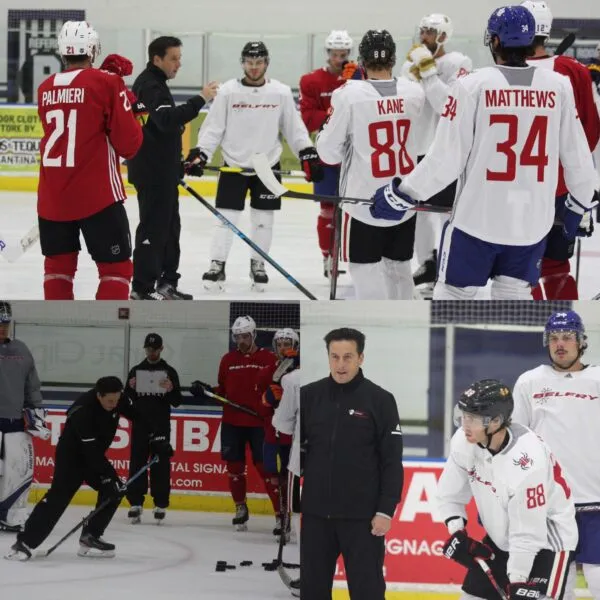 Darryl Belfry NHL summer camp // Belfry Hockey
According to Belfry’s philosophy, creativity in hockey rests on three pillars:
-
Technical excellence: The player must develop skating, puck handling, passing, and shooting to a master level, so that these movements function automatically under pressure and at high speed without conscious thought. When these fundamentals are automatic, the player’s attention is directed not at technique, but at understanding game situations and making creative decisions.
-
Game intelligence and perception: Belfry emphasizes that the foundation of creativity is “reading” the game and recognizing opportunities instantly. How do we read the game? With peripheral vision and spatial awareness. Playing with one’s head up allows the player to see the entire rink while also handling the puck. Developing this skill requires targeted practice, deliberate training, and repetition, but in the long run it significantly improves a player’s performance and confidence on the ice.
-
Proactive problem-solving: Creativity in hockey often involves players solving the challenges posed by game situations, for example how to break through a tight defense or how to create a scoring opportunity. According to Belfry, this ability can be developed through practicing real game scenarios.
Belfry’s “game reading lens” concept
Darryl Belfry, a recognized skill development expert in the hockey world, uses the concept of the “game reading lens” to express that every player sees and interprets the events on the ice differently, as if watching the game through a unique pair of glasses. This “lens” is composed of the player’s experiences, technical skills (such as skating and shooting ability), and mental capabilities (such as quick decision-making). According to Belfry, this personalized perspective is crucial because it helps coaches understand how a player thinks, and to tailor training accordingly to develop their creativity as effectively as possible:
-
Unique perspective: Every player “reads” the game differently, depending on what they focus on. For example, Auston Matthews, the NHL star, primarily looks for shooting opportunities to score goals, while Patrick Kane focuses on puck handling and the playmaker role - setting up teammates with passes. Belfry’s job is to recognize these individual strengths and design training sessions that exploit them. For instance, if a player makes quick decisions but frequently misdirects passes, Belfry introduces drills that preserve quick decision-making while also developing passing accuracy - for example, rapid passing exercises in tight spaces.
-
Creative development: Belfry does not force the same playing style onto every player; instead, he builds on their natural strengths while teaching them new skills. For example, if a player instinctively positions themselves well but doesn’t take advantage of space-gaining opportunities (e.g., doesn’t move into open areas), Belfry designs sessions that practice quick direction changes or deceptive movements, making the player even more effective. This approach is creative because it respects each player’s unique style and does not try to force them into a uniform mold.
-
Situation recognition and adaptation: The “game reading lens” helps players recognize game situations more quickly - for example, an open teammate or an approaching opponent - and respond to them effectively. Belfry uses video analysis and simulation exercises for this purpose. For example, he might show Auston Matthews on video how to watch defenders’ movements in order to find the best shooting angle. The goal is for the players’ “lens” to become sharper - that is, for them to be able to quickly analyze complex situations and find creative solutions.
-
Personalized feedback: Belfry does not give general advice such as “be faster,” but rather specific, player-tailored guidance. If a player responds slowly under pressure, Belfry might suggest, for example, improving the timing of their puck handling or changing their body position in order to make decisions more quickly. This personalized feedback helps the player become more confident and try out more creative solutions.
How does a creative attack build up according to Belfry?
According to Belfry, a creative attack in hockey is not random, but a structured process built on the following elements:
- Automating fundamental skills
The foundation of a creative attack is that players can skate, handle the puck, and pass at a masterful level. Automating technical skills frees up cognitive capacity, enabling players to make creative decisions under pressure. Belfry emphasizes that the player must be able to execute fundamental movements “without thinking,” so they can direct their energy toward innovative solutions. In training, Belfry uses exercises that develop technical skills within real game situations.
- Practicing transitions between movements
Hockey is a dynamic sport where creative attacks often depend on fast, seamless transitions between movements - for example, moving from a deke into a pass or a shot. The ability to make smooth transitions between movements is crucial for creative players. According to Belfry, practicing transitions allows players to create unexpected combinations.
How does it work? In Belfry’s training sessions, players perform drills that simulate transitions between movements, sometimes involving two or three different technical moves.
- Deep understanding of game situations and perception
According to Belfry, the foundation of a creative attack is the rapid assessment of game situations, for which a raised head (peripheral vision and spatial awareness) is indispensable.
- Proactive problem-solving and decision-making
A creative attack often involves players solving the challenges posed by game situations, such as breaking through a tight defense. According to Belfry, creativity depends on problem-solving thinking, which can be developed effectively with CLA. Belfry creates a training environment that forces players to find creative solutions, for example through a reduced ice surface or special rules (e.g., no long passes allowed). This encourages players to devise new strategies.
- Mental techniques and habits to increase creativity
Belfry emphasizes that creativity is not only a physical but also a mental skill that can be developed through habits and techniques, since visualization and positive self-reflection enhance creative thinking and the automation of technical skills.
In Belfry’s training sessions, players frequently engage in visualization exercises, for example imagining how they execute a new move or transition. In addition, the culture of positive feedback and acceptance of mistakes helps children experiment more boldly.
Practical methods of creative movement development
Deliberate play
Creative movement development is crucial for elite hockey players aged 6-12, particularly through versatile play and nonlinear pedagogical approaches. Deliberate play is an unstructured, intrinsically motivated activity that allows young hockey players to freely experiment with new movements and strategies. For example, in informal small-sided games or street hockey, without rigid rules or coaching instructions constraining them. According to Côté and Hay (2002), this playful environment is particularly effective for developing creativity, because it stimulates divergent thinking, enabling children to try out various movement patterns (Runco, 2014).
In hockey, particularly in the beginner (ages 2-6) and exploratory (ages 7-9) stages of the Creativity Development Framework, deliberate play - for example, 3v3 small-sided games with minimal coaching intervention - encourages children to boldly try out new ideas, increasing their self-confidence and creative problem-solving ability. This is beneficial not only on the ice, but in other areas of life as well. This is why we created the Grundhoki program, where on weekends, players from U8 to U14 in every age group can try out the techniques learned in training during friendly, non-contact games.
Unstructured, free play - such as informal pond hockey - is key to developing the creativity of young hockey players, as it allows them to experiment with new movements without judgment or strict rules. The example of Minnesota Hockey programs shows that publicly recognizing creative attempts, even when they are unsuccessful, significantly promotes players’ creative thinking and long-term development.
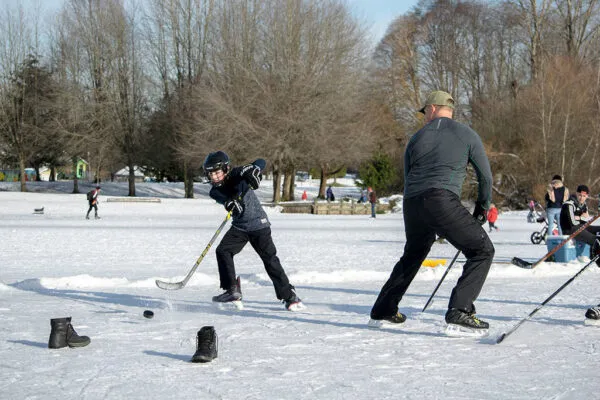 Unstructured outdoor play // by City of Toronto
Parents can also actively support their child’s creative development by encouraging unstructured play - for example, inline hockey, freestyle skating, or informal hockey games - and by providing opportunities to try other sports such as basketball or soccer, which also develop passing play, movement versatility, and creative thinking.
Nonlinear pedagogy
Nonlinear pedagogy, particularly the Constraints-Led Approach (CLA), is an effective training method that allows players to discover creative solutions in various situations. CLA uses manipulation of environmental, task, and individual constraints to encourage children to try out new movement patterns and strategies. (For example, in training, a smaller ice surface or a reduced number of players forces children to be creative, as the confined space provides less time and room for traditional solutions.)
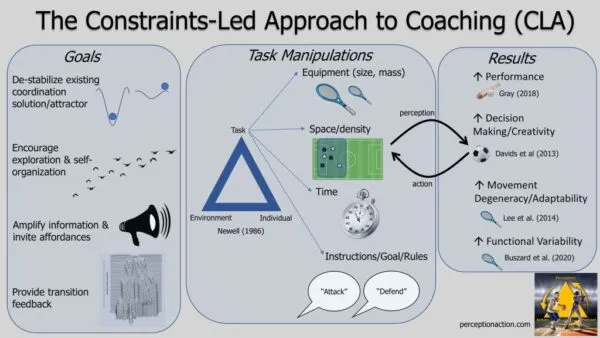 CLA // perceptionaction.com/cla/
This approach is particularly effective in the 6-12 age group, when creative thinking and movement fluency - that is, the ability to make smooth transitions between movements - are developing intensively.
Teaching Games for Understanding
Similarly, the Teaching Games for Understanding (TGfU) method focuses on teaching the principles and tactical elements of the game, rather than exclusively emphasizing technical skills. With TGfU, young players understand the strategic aspects of hockey, such as positioning or the exploitation of offensive zones, which promotes tactical creativity. For example, in a TGfU-based training session, children in a 4-on-4 game can practice how to move the puck quickly in the offensive zone, trying out different passing routes. This method allows players not only to execute movements mechanically, but to understand how to apply them creatively in game situations.
Mindfulness- and acceptance-based psychological interventions in developing hockey creativity
In hockey, developing creativity is not just about perfecting technical skills and tactical understanding, but also about strengthening mental skills that allow players to make new, innovative decisions even under pressure. Acceptance and commitment-based psychological tools and Acceptance and Commitment Training (ACT) offer further possibilities for enhancing creativity and performance.
The goal of ACT is to increase psychological flexibility - that is, for people to accept negative thoughts and feelings without allowing those to control them, while committing to action based on their values. It has six key processes:
-
cognitive defusion (reducing the literal interpretation of thoughts),
-
acceptance (allowing internal experiences),
-
present-moment awareness (mindfulness in the moment),
-
self-as-context (perceiving a stable sense of self),
-
values identification (what matters in life), and
-
committed action (taking steps toward goals).
It is widely used in psychology to treat anxiety, depression, addiction, and chronic pain; in sports psychology it improves performance, motivation, and creativity - for example, in hockey it helps maintain focus under pressure and make risky decisions.
This approach helps players make bolder, risky, creative decisions - for example, attempting a new deke-pass combination against a tight defense. ACT has been proven to improve objective performance as well as coach-rated focus and creativity among elite junior hockey players (Lundgren, 2020).
Integrating ACT and mindfulness-based approaches into hockey training, particularly in the enlightened (ages 10-12) and creative (ages 13-15) stages, complements technical and tactical development so that players become more creative and mentally stronger both on and off the ice.
Perceived competence
Perceived competence (PC) - that is, the belief about how capable a player feels of executing a given skill or task - has a significant impact on creative performance. Perceived competence is based on Susan Harter’s competence motivation theory, which states that athletes’ self-confidence and motivation are closely linked to how competent they feel in a given area. High PC increases players’ willingness to make risky, creative decisions, as they are less afraid of making mistakes and experiment with new solutions with greater confidence. By contrast, low PC can trigger anxiety, which inhibits divergent thinking - the ability to find multiple solutions to a problem.
Research shows that PC plays a key mediating role in how athletes’ motivation translates into concrete behavior in team sports, and has been proven to increase creative performance. Task-focused perceived competence, which concentrates on one’s own development and skill acquisition, increases persistence and creative problem-solving. In contrast, ego-oriented perceived competence - which is based on performance relative to others - can limit creativity if the player does not feel good enough.
With high PC, players are more likely to carry out original and functional actions, as they build on their motor skills (e.g., movement fluency) and adapt more boldly to the flow of the game. PC also promotes the flow experience, which creates ideal conditions for creative decisions.
Different perceptions in forwards and defensemen
In hockey, the effect of perceived competence is position-dependent, resulting in significant differences in creativity between forwards and defensemen. Forwards generally feel stronger in offensive competencies, for example in goal scoring, puck handling, or creative play in the offensive zone. This high PC encourages them to make risky, creative attacks.
By contrast, defensemen feel more competent in tactics and physical strength. This perception supports defensive creativity, such as innovative positioning, blocking techniques, or launching quick counterattacks, but it less frequently encourages offensive creative actions, since their role is primarily focused on defense.
The position-dependent differences are partly due to the relative age effect discussed in our earlier article. Those born at the beginning of the year and early developers often experience higher PC in tactics and strength, which provides an advantage in creativity: in an offensive context for forwards, and a defensive context for defensemen.
Perceived competence not only increases creativity but also long-term athletic participation, since confident players are more likely to stay in the sport and actively seek out development opportunities.
Multisport and creativity
Participating in multiple sports simultaneously or seasonally brings significant advantages for developing the creativity of young hockey players. Different sports develop varied movement patterns and decision-making skills that are transferable to hockey, thereby increasing players’ ability to devise creative solutions. According to a 2022 study by Hüttermann and Memmert, creative actions in team sports are primarily based on players’ movement skill repertoire, not on divergent thinking abilities. This means that the versatile movement skills developed through multisport participation - such as agility from basketball or spatial awareness from soccer - help hockey players devise new solutions.
According to the Creativity Development Framework, multisport is particularly important in the beginner (ages 2-6) and exploratory (ages 7-9) stages, when children acquire fundamental movement skills (such as skating and balance) and game skills (such as puck handling). According to a 2025 study by Luukkainen, multisport participation significantly improved children’s motor competence after three years.
In hockey, creativity depends not only on perfect technical skills but also on physical fitness and physiological factors. Good fitness allows players to make innovative decisions under pressure, even at the end of games. Multisport improves physical condition in a playful way, specifically aerobic capacity, strength, coordination, and agility. High aerobic capacity (VO2max), rapid phosphocreatine (PCr) resynthesis, and complex training programs are key to reducing fatigue and supporting creative decision-making.
The negative effects of early specialization
Early specialization - when a child focuses on a single sport such as hockey from a young age - can have several negative consequences that can inhibit creativity and long-term athletic development. Research shows that early specialization increases the risk of burnout, which can result in physical and emotional exhaustion, reduced motivation, and dropout from the sport (according to Côté’s 2009 study, swimmers who specialized early remained on the national team for a shorter period and retired earlier than those who specialized later). This also applies to hockey, where due to early specialization, children often lose their passion for the game, particularly when excessive coaching control and the pressure to win dominate.
Moreover, early specialization can reduce movement variability - that is, the ability to acquire different movement patterns - which limits players’ adaptability and creativity. Training players restricted to repetitive movement patterns slows overall motor development (Frantz, 2024), which reduces the ability to devise creative solutions in new situations. Multisport participation, by contrast, develops varied movement patterns - for example, jumps derived from basketball or footwork borrowed from soccer - which increases hockey players’ adaptive and creative abilities.
The problems of the full-ice performance pressure
Modern youth hockey is often overly structured, because the introduction of early tactical systems and excessive coaching control focuses on short-term success. Complex breakout systems or defensive formations that exceed children’s cognitive capabilities are often taught as early as age 8-10, simultaneously restricting their creativity. Coaches frequently give too many instructions - for example, telling players exactly when to pass or where to skate - which prevents children from making independent decisions, and thus they never learn to “read” the game.
Excessive structure reduces children’s enjoyment and can take away their passion for hockey. If children only follow predetermined systems and never learn to think and decide independently, they will be at a disadvantage in higher-level leagues that are built on quick decisions and creativity. An interesting aside: the player agency that represents the biggest NHL stars is called Creative Artists Agency - one might wonder why.
If a 10-year-old child only hears that they should always pass in a given situation, they will not develop the ability to recognize when a deke or a shot would be better. That is why less structured play is often better - such as small-sided games or street inline hockey - which gives children the opportunity to freely experiment and play, increasing their self-confidence, competence, and creativity.
Teaching 5-on-5 full-ice game systems in hockey simultaneously helps and challenges players’ creativity. In his book Belfry Hockey, Darryl Belfry emphasizes that these systems provide structured frameworks for positioning, passing lanes, and pressure management, which develop game intelligence and quick decision-making. To maintain creativity, Belfry recommends flexible application of systems - for example, by practicing individual moves or unusual passes through small-area games. In leading hockey nations, structured 5-on-5 tactical training begins in the U14-U16 (ages 12-15) age group, while basic tactical elements are taught in a game-based format in the U10-U12 (ages 8-12) age group.
Talented players must be careful to preserve their individual style alongside mastering tactical systems. Belfry emphasizes that more talented players can support their teammates as mentors, while taking a leadership role through creative application of systems - thus striking a balance between tactical discipline and individual expression.
Only positive - how does shouting affect children?
In children, shouting - especially during training or games - significantly affects their performance, motivation, and creativity, but its effect depends on what message it conveys.
According to available research, children comprehend only 30-60% of shouted instructions; since they often cannot hear or understand the instruction, a self-reinforcing cycle of shouting and non-comprehension develops, which generally leads to fatally poor performance on the ice.
Instead, simple, positive, and visually supported communication better promotes the flow experience, allowing children to become absorbed in the joy of the game and the flow of the activity.
When a coach or parent encourages children toward speed and motivation - for example, with phrases like “skate,” “come on, go, faster!” - the focus is on effort and action, not on the quality of their decisions.
Shouting that encourages speed and motivation, such as “skate,” “come on, go, faster!”, reinforces a task-involving environment, which according to sports psychology research positively influences motivation and performance. According to a 2012 study, positive feedback and encouraging communication - for example, “come on, let’s go!” - increases young athletes’ self-esteem and enjoyment of the game, especially when the tone is supportive and not aggressive (Horn et al., 2012).
For older children (ages 10-18), who are better able to process verbal instructions, speed-encouraging shouting can be particularly effective if perceived as encouragement. However, due to the limited attention and cognitive capacity of younger children (ages 2-9), they have more difficulty processing shouted instructions, especially in a noisy environment like a hockey rink. Due to the short attention span of the 2-6 age group, visual cues - such as hand gestures - are more effective than verbal instructions. Thus, instead of shouting “skate, faster!”, simpler visual encouragement is recommended, such as demonstrating skating faster.
The main difference between speed- and motivation-encouraging shouting and shouting that criticizes decisions lies in focus and mechanism of effect. The former reinforces a task-involving environment, which according to sports psychology research positively influences motivation and performance, while the latter creates an ego-involving environment that can cause anxiety and reduced performance. According to the American Psychological Association (2019), positive reinforcement such as “come on, let’s go!” is more effective in shaping behavior and improving performance than punishment or criticism. Research indicates that speed-encouraging shouting, when supportive, can increase motivation, especially in older children, but is less effective in younger children because they have more difficulty understanding it. Shouting that criticizes decisions, by contrast, can cause anxiety, inhibiting creativity - especially in younger age groups.
By contrast, when shouting criticizes decisions - for example, “why didn’t you pass?”, “pass it!” or swearing at the team - it evaluates performance in a negative context, causing anxiety and tension. In younger children, this significantly inhibits the formation or maintenance of the flow experience, as it disrupts attention, increases stress, reduces intrinsic motivation, and makes specific goals unclear. Incidentally, would any adult enjoy working in a workplace where, with minimal career opportunities, their boss stands behind them and loudly berates them for every wrong decision? So why would this be good for developing children?
It is important to understand that the effect of shouting depends on the tone, the situation, and the child’s individual sensitivity: a supportive, encouraging style increases self-confidence and creativity, while critical or overly directive instructions can trigger anxiety, inhibiting players’ willingness to experiment and their long-term development. Coaches and parents alike play a key role in supporting young hockey players’ motivation and creativity through appropriate communication. Coaches should employ positive, supportive shouting - for example, “come on, let’s go, faster!” - and avoid decision-criticizing criticism that can cause anxiety. Parents should support their child at home as well - for example, saying “well done, try it faster!” - and encourage coaches toward positive communication, while themselves avoiding negative criticism that can reduce the child’s self-confidence.
For more vocal parents, it is important background information that, as we also wrote in our article about player scouts, at select teams not only the child’s ability is observed, but also the parents’ behavior - since most problems are caused not by the children but by the parents. Hockey will also be much more enjoyable for parents (not only because of fewer physical conflicts), if at games everyone sincerely cheers for their own team and does not concern themselves with someone else’s child.
The effect of physical play and penalties on creativity
Research shows that penalties can reduce creativity because they restrict forwards’ range of motion and technical skills. The 2005 NHL rule changes, which penalized stick penalties more strictly, increased the goals-per-game average (from 2.57 to 3.03), especially in power play goals (from 0.70 to 1.03). This suggests that fewer stick penalties gave more opportunities for creative play, especially during power plays, but even-strength goals also increased slightly (from 1.87 to 2.00), because skilled play had more space. Reducing penalties not only increased creativity but also improved player safety, reducing the risk of injury, especially in younger age groups.
Stick penalties, such as slashing or hooking, are most often used by defenders to stop more skilled forwards. However, research suggests that these penalties can reduce creativity because they restrict forwards’ range of motion and technical skills, while also providing no real development for the defending player.
In both Canada and Sweden, there is an observable trend toward delaying the introduction of physical play, so that players concentrate more on technique and tactics than on physical aggression. This is particularly important from the perspective of creativity, as young players can spend more time refining their skills, which in the long run can be more beneficial for the enjoyment and development of the sport.
The data and expert opinions suggest that stricter penalties and raising the age threshold have a positive effect on creativity, but further research is needed to determine the exact long-term effects.
Technology and innovation in developing hockey creativity
Modern technologies are revolutionizing creativity development in hockey, supporting players’ decision-making and movement variability with real-time data. Virtual reality (VR), video analysis, performance tests, wearable technology, augmented reality (AR), and AI-based analytics create a safe environment for experimentation, especially in the enlightened (ages 10-12) and creative (ages 13-15) stages of the Creativity Development Framework, where fatigue can inhibit innovation.
Virtual reality (VR), such as the NHL Sense Arena, offers realistic simulations, enabling players to practice skating, puck handling, and passing risk-free. Video analysis makes it possible to analyze creative moves (e.g., dekes, passes), encouraging experimentation through targeted feedback. Video analysis helps identify creative behavior - for example, the number of dekes, the frequency of unexpected passes, or unique game solutions during a match. It enables coaches to measure the variety, effectiveness, originality, and versatility of movement patterns. Without video analysis, it would be impossible to determine how often a 12-year-old forward tries new dekes and how effective those are in advancing the attack.
Performance tests, such as Design Fluency, measure the variety and originality of movement patterns, helping coaches design targeted exercises. Based on the test of an 11-year-old player, deke accuracy can be improved, while at age 16 and above it is suitable for developing complex strategies (Lundgren et al., 2016, DOI: 10.1123/jcsp.2015-0030).
Wearable technology collects biometric data (heart rate, speed), reducing fatigue and increasing the possibility of creative decisions. HELIOS sensors provide immediate feedback, and Catapult systems improve motor learning by 20%, encouraging risky maneuvers (Charlotte Hockey Lab, 2025).
Augmented reality (AR) projects data into a real environment - for example, NHL Edge passing lanes - encouraging new tactical solutions. According to Sports Medicine Open (2025), AR increases tactical creativity by 15%, inspiring players to adapt the styles of NHL stars. AI-based analytics analyze performance with predictive models, identifying creative weaknesses. Sportlogiq’s iCE measures movement variability, Drive Hockey Analytics improves skills by 25%, while the San Jose Sharks system suggests new offensive patterns (Sportlogiq, 2025).
In any case, becoming a rocket scientist comes first
For a Hungarian upper-middle-class child who plays hockey, the path to becoming a neurosurgeon or “rocket scientist” is far more likely than becoming an NHL player. The numbers speak for themselves: based on statistics, the chances of becoming a rocket scientist are 2-15 times greater, and those of a neurosurgical career are 2-10 times greater, than making it from Hungarian ice rinks to the NHL. For even the most talented young players in Hungary, an international hockey career poses nearly insurmountable obstacles, which is why families and those involved are better off concentrating on the joy of the game, enjoying the whole process.